About Me

My photo
I am a mother, educator, traveler, and reader with boundless curiosity.
Showing posts with label Andy and the Lion. Show all posts

Wednesday, September 15, 2021

James Daugherty Caldecott Honoree: An American Artist of his Time


Sketch of artist in black, white, and yellow, hunched over easel and painting in a crowded studio filled with frames and books
(Self-portrait from "Foreword" in
West of Boston: Yankee Rhymes and Doggerel)

James Daugherty (1887-1974) was a prolific artist who was active from his youth at the turn of the century to his death in 1974 -- and by all accounts, his vision was just as fresh and forward-looking in the 1970s as it was during the 1910s. He received two Caldecott Honors: One in 1939 for Andy and the Lion, which he also wrote, and the other in 1957 for Gillespie and the Guards, written by Benjamin Elkin. He also won the 1940 Newbery for his own Daniel Boone. He carries illustrator credits on 104 books, 15 of which he also wrote; a full bibliography is available at the Friends of James Daugherty Foundation.

Who Was James Daugherty?

There are multiple places to find a basic biography of this great artist. The Friends of James Daugherty Foundation posts the definitive James Daugherty Chronology, which is more comprehensive than the standard Wikipedia biography. You can also can find short but good biographies at the Connecticut State Library and nocloo.com

Beyond names, dates, and places, there is a lot to learn about James Daugherty from his writings, as well as reflections on him and his work by colleagues, friends, and students of his work. Looking here, I saw him as a well-read man of faith who loved his family and his country. That said, his patriotism did not blind him to the inequities and problems around him. He fully recognized that the Unites States had not realized the ideals on which it was based, and he understood the challenges that we still had to overcome. However, he celebrated the progress that those before him had made and believed in the wisdom and power of the next generation to go even further -- and he saw art and the free expression of ideas as critical to helping them achieve this promise.

With that said, not all of his work would hold up for modern audiences. In fact, his book Daniel Boone is the first (only?) Newbery-winner to be taken out of print due its depictions of Native Americans, although it is still available on some library shelves. Such questionable, if not simply offensive, images pop up here and there in his other works as well. I bring this up not to detract from his achievements but simply to raise the red flag for those who may be interested in seeking out more of his considerable work. As you will see if you scroll below, much of his work is quite powerful and often forward-looking. 

In fact, I think if Daugherty were alive today, he would be more likely to hear and accept such feedback on his work. He truly believed in the ideals of his country and understood that we had not attained them. More important, he trusted the next generation to know more and do better. As he stated in his Newbery Acceptance Paper for Daniel Boone: "Let us not be betrayed and put to sleep by the past. Let us look more realistically and idealistically at the present in our won land -- these teeming grade and high schools, with their dynamic young Americans stepping out on the great adventure of living, call for fresh and candid thinking" (p. 189). 

However, nowhere is his faith in the future vision clearer than in his poem "Graduating Class" from West of Boston:
In time of doubt, change, confusion, the future uncertain,
when there is no turning back, standing still, no backward look, no retreat,
a new generation springs up crying, asking, "Mister, which way peace with justice on the side?"
They keep coming, marching, rushing up like the green corn,
upspringing, full of green sap, shooting toward the sun,
pushing on upstream toward the uplands on the long ascent,
following the western star beyond the old boundaries into new country,
unmapped, uncharted, always forward-advancing, pausing and then pushing onward,
as long as the grass shall grow and the rivers run.

These are only a sample of what American democracy can do at turning out first-rate men and women . . . maybe not all experts or geniuses, but maybe better, having sound character and native intelligence.
Because this enterprise, these States, this freedom, is still so new, 
this liberty so green . . .only a start toward possibilities
infinite, horizons unlimited (p. 70-71)

Given these expressions, I find it difficult to believe that he would NOT want to hear and learn from audiences today.

Below is a chronology of words and works by and about James Daugherty. It is by no means exhaustive, as he was quite prolific (According to Lynd Ward, he completed a full drawing every 15 minutes.). I hope, though, that it gives an idea of his art. 

(As a side note: I have not purposely included any potentially objectionable illustrations because I really don't want to keep those types of things in circulation or detract from the larger body of his work --especially since there is a lot of beauty there. I have, however, noted books where I recall seeing such illustrations. My intention wasn't to detract from the art shown or to incite; I just didn't want anyone who may seek out the books to be surprised by them. On the other side of that: If something I posted is problematic, please email me through the blog. I am aware that my perspective may blind me to things, and I am ready to learn and make corrections.)


1914-1970
From James Daugherty: Late Abstractions. New York: Spanierman Gallery LLC, 2002.

1914: Circle with what seems to be many women in a cubist style. Effect is like a stained glass rose window. 1922: Rectangular painting that almost looks like a fragmented picture in a shattered mirror, featuring bright yellow, red, green, and blue with touches of white and black. 1953: What looks to be a bold, black letter “H” overlaid on overlapping planes of gray, red, and beige. 1958: Two seated figures, one blue one red, facing each other. Many color overlays in shades of blue and red. Background features gray, black, white, yellow, and green. 1961: Rothko-like picture featuring a dark yellow sun on a lighter yellow background atop two layers of red. Along the left side, there is a translucent yellow bar. 1970: Another circle painting. Features several geometric shapes with curved sides and edges in pinks, blues, browns, yellows -- with some white and green highlights.

When you draw really freely, letting the lines go for a walk on their own, they begin to answer each other in a sort of rhythmic dance -- James Daugherty, Introduction to West of Boston: Yankee Rhymes and Doggerel. New York: Viking, 1956, p. 8

1928

From Sandburg, Carl. Abe Lincoln Grows Up. Illustrated by James Daugherty. New York: Harcourt, Brace and Company.

Young Abe wiping his brow and resting on a stump after chopping down a tree.


Line drawing of Lincoln's profile as a young man, picture if him as a late teen reading by candlelight, Picture as a boy rolling on logs

"Abe Lincoln Grows Up . . .reached a new high in compatibility between text and pictures. Daugherty established an very vital relationship between the words and the drawings. The book became the union of these two inseparable elements" -- Lynd Ward, "Biographical Note: James Daugherty" in Newbery Medal Books: 1922-1955 with their Author's Acceptance Papers and Related Material chiefly from the Horn Book Magazine, p. 182

Ward's praise is fitting, but there are some depictions that likely would be omitted if the book were reprinted today. The focus, however, is on Lincoln.


1933-1939
From "James Daugherty (1887-1974): American Modernist Works on Paper from the New Deal Era [1933-1939]." New York: Janet Marqusee Fine Arts.

Murals and close-ups of contemporary America and more abstract work

Collage of women from ancient through modern times in blues, reds, browns, yellows, and white

"Life Magazine in October 1937 devoted several pages to Daugherty's mural commission . . .The article's headline reads 'A SHY ARTIST PAINTS BOLD MURALS: JAMES DAUGHERTY'S FAVORITE SUBJECT IS AMERICA' and describes the artist as a 'soft-spoken blue-eyed man who . . . paints with a flamboyance and vigor that belie his diffident manner. Violent in color and sweeping in subject . . . Daugherty is well equipped to depict the American scene" -- Janet Marqusee (p. 6)

". . .Daugherty has directed his talent towards the rendering in visual terms the roots of American life. He has chosen two forms in which to channel his expression, the book and the mural. It would be difficult to find two media more widely separated from the point of view of physical size, but beneath this apparent disparity there exists a logical unity that reflects the basic motivation of Daugherty's work . . .both of these media imply talking to a large audience and saying something to that audience that shall be both articulate and meaningful. This is precisely what Daugherty does and his work in each form gains sustenance from his experience in the other" -- -- Lynd Ward, "Biographical Note: James Daugherty" in Newbery Medal Books: 1922-1955 with their Author's Acceptance Papers and Related Material chiefly from the Horn Book Magazine, p. 181

I think that children's literature is much devitalized by the reluctance of writers and artists to look the present in the face. If Huckleberry Finn is a great national classic, the great American juvenile, it is partly because an artists looked at it, and keenly sympathized with, what he knew and lived. I imagine the Lower Mississippi was just as dull and drab then as now, and the colorless vagrants of the river towns were not then the fictional material that they have since become. . . --James Daugherty, "Daniel Boone Acceptance Paper," in Newbery Medal Books: 1922-1955 with their Author's Acceptance Papers and Related Material chiefly from the Horn Book Magazinep. 187


1938
From Andy and the Lion, a Caldecott Honor book. Illustrated and written by James Daugherty. New York: Viking, 1938.

Andy and the Lion chase each other around a rock -- multiple images of each, almost like a cartoon flip book -- show speed. Colors are black, white and yellow.

"The book is gay both in its physical aspect where a yellow second color appears on every page and in its spirit of happy, carefree childhood, where fact and fancy combine in a world far more real than the prosaic pedestrianism of adult years" -- Lynd Ward, "Biographical Note: James Daugherty" in Newbery Medal Books: 1922-1955 with their Author's Acceptance Papers and Related Material chiefly from the Horn Book Magazine, p. 183

"The admirable brevity of the tale is also worth notice. Every step is here, but not one unnecessary word, with the result that the reader feels he is moving as rapidly and sometimes as breathlessly as the lively young hero. . . The drawings of Andy and the lion running rapidly around the rock . . .convey an amazing sense of motion . . . a rollicking good humor which young readers find irresistible" -- Anne T. Eaton, New York Times Book Review, May 22, 1938


1939
From Daugherty, James. Daniel Boone. New York: The Viking Press. This book won the 1940 Newbery Award. Again, this book is out of print due to its depictions of Native Americans. Since I think that decision says enough about them, I have not included any below.
Picture of Daniel Boone with plow, as a young man talking to a young woman, two views of the Kentucky wilderness, one image of a bison and other animals. Colors are pale green, sepia, black and white.


"Unlike many who seek to recreate in terms of art the vital qualities of our heritage from the past, Daugherty is able to give you a sense of having been there himself and known the qualities of those earlier experiences firsthand" -- Lynd Ward, "Biographical Note: James Daugherty" in Newbery Medal Books: 1922-1955 with their Author's Acceptance Papers and Related Material chiefly from the Horn Book Magazine, p. 182

Certainly the vast and fantastic epic of America is a rich storehouse of true stories that make the legends of Greece and Old Europe seem trivial and tame, Instead of a handful of bad-tempered national heroes, we have a vast lore of actual saints, desperadoes, romantics, inventors, robber barons, Indian chiefs and rail-splitters roaring across the plains and mountains in a cavalcade so fierce and gaudy, so splendid and ragged, so near and so real that a whole race of writers and artists is needed to sing and to image it, make books and plays and symphonies, sculptured friezes and murals in libraries -- celebrating the nation composed of all nations marching on the long, rough road to freedom -- James Daughtery, "Daniel Boone Acceptance Paper," in Newbery Medal Books: 1922-1955 with their Author's Acceptance Papers and Related Material chiefly from the Horn Book Magazinep. 187


1941
From Thornton, Willis. Almanac for Americans. Illustrated by James Daugherty. New York: Greenberg Publisher, 1941, 1954. 

Detailed black and white sketches commemorating World War I, Lewis and Clark,Mayflower landing, Fourth of July, Lincoln signing the Emancipation Proclamation


Although these words are penned by Willis Thornton about the book and don't concern Daugherty, I could see him nodding his head in agreement:

"Just as some people go to church twice a year -- at Easter and at Christmas -- so there are some who turn a conscious thought to patriotism and its background in the history of the Republic only on the Fourth of July, and possibly on the birthdays of Lincoln and Washington. 

The thought of the past struggles of our people to gain what they have gained ought to be more consistently with us. So rich in incident has our history become, that every day of the year has long been graced with a memorable event. . . I hope [this book of days] may give to many the sense of fullness of the crowded story of America, in which every day of the year has its testimony to make. . ." -- Preface to Almanac for Americans.

Two full-page detailed black and white sketches that feature larger-than-life depictions of Custer and Lincoln in a whirlwind of activity and energy


1943
From Daugherty, James. Abraham Lincoln. New York: The Viking Press, 1943.

1. Sepia drawing of Lincoln and another man in law office; Lincoln is sitting to the side of a desk, reading a paper, with another in his other hand. Rolled documents sit sticking out of his top hat , which is sitting bottom-up on the floor. 2. Title page of the book featuring a solemn portrait of Lincoln. 3. Young Lincoln at a dance. 4. Lincoln on the caboose of a train talking to a crowd. 5. Army soldier sitting and adjusting his boot. 6. Army wounded; a nurse bandages one soldier's head in the foreground.


1947
From Lincoln's Gettysburg Address: A Pictorial Interpretation Painted by James Daugherty. Chicago: Albert Whitman & Company Publishers, 1947, 2013.


Collage of excerpts 1930's style paintings of various idealized scenes from American history, including Founding Fathers under a rainbow, women comforting each other, soldiers comforting each other,  a woman holding a baby, an eagle flying. Vibrant colors.

Again we have stood at the close of a great war, the most terrible in history, with the unfinished task before us. At a time when events, directions, and purposes seem confused and the path ahead clouded and obscure, Lincoln's words are clear, strong, comforting, eloquent of the central idea. The stupendous rush of history has not ignored but expanded their deepest meanings. . . In spite of the failures and the betrayals, the long delays and setbacks, we the people have not failed. Our voice has spoken out clear and strong the testament of liberty. . . -- James Daugherty, Weston Connecticut, Introduction 

 For more about the book, check out the Kirkus Review.

1954
From Elkin, Benjamin. The Loudest Noise in the World. Illustrated by James Daugherty. New York: Viking.

Six Pictures: 1. Kids making noise; 2. Top of a Tower looking down to own; 3. Two men with extremely pointed noses; 4. Welcome to Hub-Bub plate with chaotic noise-making behind; 5. Book Cover featuring King and prince dancing; 6. Phone Operators madly calling around the world

In her New York Times book review, Ellen Lewis Buell wrote, ". . .James Daugherty makes the book as good to look at as it is to hear" (March 21, 1954). It is certainly a fun story, but its depictions of non-white cultures will offend modern audiences. (See my Goodreads review.)

1955
From Miers, Earl Schenck. The New and Revised Edition: The Rainbow Book of American History. Illustrated by James Daugherty. Cleveland and New York: The World Publishing Company, 1955 (Second Edition, 1962).

Title, author, illustrator and publisher credits atop colorful collage of historical figures. Uncle Sam sits looking out upon a female and male soldier saluting, Conestoga wagons traveling out into distant hills, a man with back facing us carrying a rifle, Davy Crockett or similar character with an eagle on his shoulder. Eagle has wings outstretched and appears to be cheering.


Black, red, white, blue and yellow portrait of George Washington looking satisfied but solemn atop his horse. On the right, "Six Eggs: Booker T. Washington Builds a School." Text is flanked by images of African Americans, Three boys lean in together enjoying a book. A woman with a headscarf carries a basket of eggs. A man with his back to us steers he horse-drawn wagon.
Four portraits. 1. Red, white, blue, and brown drawing of Edison with his light bulb. 2. Same colors used to show a family gathered around the TV. 3. Sepia and black sketch of Ben Franklin or "Poor Richard." 4. Red, white, blue and brown sketch of Buffalo Bill on horseback with mountain in the background.


1956
From Elkin, Benjamin. Gillespie and the Guards. Illustrated by James Daugherty. New York: The Viking Press. 1956. 

Marching Scene: Rotund king, young boy and royal guard are high kicking off the page. In brown, black and white.


From Daugherty, James. West of Boston: Yankee Rhymes and Doggerel. New York: Viking, 1956.


Black, white and yellow sketches depict: A parade of young people marching and reaching forward in "Graduating Class"; Two pigs alongside towering corn plants in "Buckeye State"; a chilling nuclear mushroom cloud forming a skull; Bison roaming free with a swan in the foreground; A long gondola passing in front of a domed building on a hill; a bear and a man seemingly dancing together.


Modern, edgy depictions of the following in black, white and yellow: Close up corn husks, the Golden Gate bridge with sun on the horizon and rays beaming; Henry David Thoreau; and sun rays in the Redwood Forest

William Blake claimed that the old timers from away back used to drop in and pose for him, Cleopatra, Caesar, Pharaoh, and that old Bible prophets occasionally stopped in for dinner and an evening talk. . . I think I know what he meant. 

Through the years I have made a lot of illustrations of American themes and have come to know the faces of some of the principal actors of out history -- and what faces they are! You know them yourself: Franklin, Jefferson. . .These faces have at times seemed so real to me that I have felt that my old studio was haunted and that they had really come to sit for me as Blake said -- James Daugherty, Introduction, p. 7-8.


1961
From Calvert, Captain James N. A Promise to Our Country: I pledge allegiance . . . Illustrated by James Daugherty. New York, Toronto, London: Whittlesey House, 1961.

1. Black and white sketch of four hands joining atop a mostly blue background with red flares and white stars. 2. Red, white, blue and black drawing of pioneer family following Conestoga wagons. 3.Black and white drawing a children and teacher saying the Pledge of Allegiance in a classroom. 4. Two-page title spread of the book . On left a rainbow over a town runs into a U.S. flag on the right which soars atop people proudly gazing . One woman has her hand over her heart. 5. 1776 Patriot hands off torch to a 1966 astronaut. Text reads: 'We mutually pledge to each other our lives, our fortunes, and out sacred honor."


1962
From Shapiro, Irwin. Heroes in American Folklore. Illustrated by Donald McKay & James Daugherty. New York: Julian Messner Incorporated, 1962. 

Literal Man of Steel shown ripping up rails, among other superhuman exploits.

A full review of the first story, "Joe Magarac and his U.S.A. Citizen Papers" is available at Kirkus. Also in her New York Times book review, Ellen Lewis Buell wrote, "The traditional yarns of mighty feats performed on the open hearth are bound together by the theme of Joe's yearning to be an American citizen, climaxed by his magnificent and efficient wrath when he hears a couple of Congressmen talking about the undesirability of foreigners. As vigorous as its hero, told in a gusty workers' colloquialism and perfectly illustrated by James Daugherty, this story, which won the Julia Ellsworth Ford Foundation award for 1947, will entertain...." (September 26, 1948).

I thought it was interesting (and sad) to see evidence of the same social discord we have today and think the story's stance against xenophobia must have made it stand out for its time. However, I feel a bit differently about the "gusty workers' colloquialism"; the hero's voice in particular read more like a parody of an old Tarzan movie.

I had the same feelings about language in "John Henry and the Double Jointed Steam Drill," the other story in the volume that Daugherty illustrated. Both stories were certainly well-intended; the very fact that an immigrant and an African American were placed in a volume of "American heroes" speaks to the desire of the book's creators to make them equal partners in the story of the nation. That said, the creators are still mired in their time. The dialects used, together with some of the pictures, detract significantly from the experience for today's audience. As a result, the story does not accomplish the celebration of other cultures that the creators intend -- and often has just the opposite effect.

 1964

From Walt Whitman's America: Selections & Drawings by James Daugherty. Cleveland & New York: The World Publishing Company, 1964.


Four images: 1) A woman bent over with her head in her arms at the start of the section "The War 1861-1865"; 2) Black, white and olive image of Whitman on one page leaning back and looking toward a naked man (back view) leaning forward toward a dove -- reminds you of Michelangelo's Sistine Chapel; 3) Woman with arm outstretched, inside almost a thought bubble are figures running; 4) Three portraits of Abe Lincoln that are set in a ways as if almost their own Mt. Rushmore

Poetry was food and drink in the daily life of our home. The Library of Poetry and Song was a worn volume from which my father read aloud with such contagious delight that we looked forward to long winter evenings filled with the splendor of great poetry . . . There was none of Whitman's poetry in the Library of Poetry and Song, and I suppose my father disapproved of him for the same reason Emily Dickinson wrote, "I have not read Mr. Whitman but have been told he is disgraceful" -- James Daugherty, Introduction, p. 11.

Upon finally being introduced to Whitman by an American that he met in London, Daugherty writes, Was this really my America, this splendor of democracy, this new world of affirmation and fraternity and hope? We read and chanted and roared our favorite passages to out bewildered British comrades."


Three pictures: In olive, black and white are two hands clasping under a dove. In rust, black and white are: 1) Sketch of Jesus, Moses, the Buddha, Shakespeare and other great minds of the past and 2) Spread for "Manhattan" featuring an anchor in the foreground with giant people looking up at very angular, towering buildings in the distance

Leaves of Grass got under my skin and into my bones. For the first time I felt the meaning and power of that majestic word, "America," and through Whitman's eyes I dimly glimpsed the grandeur of its possibilities. I must return to my country at once and forever -- James Daugherty, Introduction, p. 13.


1967
From Henry David Thoreau: A Man for Our Time, Selections & Drawings by James Daugherty. New York: The Viking Press, 1967.

Two Pictures. In mostly blue with black and white, the back of a muscular, shirtless man pushing against and abstract background. In rust, black and white a collage of patriotic images, including the Statue of Liberty, children of many races raising their arms to her torch with the Capitol dome in the background.


"In his book Drawings by American Artists, Norman Kent notes of Daugherty's composition that it is '. . . built up on an abstract basis of opposing linear movements that weave in and out, as well as laterally' and that it 'is the result of careful planning. A lifelong study of the baroque masters, particularly Michelangelo and El Greco, has provided the artist with a remarkable feeling for form in space" -- Janet Marqusee, "James Daugherty (1887-1974): American Modernist Works on Paper from the New Deal Era [1933-1939]" (p.6)

Four pictures. 1) "My Mouse" in rust, black and white is a close up of a mouse in a hand; 2) A squirrel gnawing an ear of corn in rust, black and white; 3) In blue, black and white, Thoreau in his cabin at Walden, reading; and 4) Owls in blue, black and white

Young Thoreau found that if he lived frugally he could earn enough in a few weeks to live for a year, So he went to the woods and built a hut by Walden Pond on land that Emerson owned and permitted him to use rent free. . . He bragged about how little it cost him to live and when he told Emerson at the dinner table that he had lived on twenty-seven cents the previous week, Lidian, Emerson's wife, said, "But Henry, you forget that you dines with us three times.'

Nevertheless, Thoreau could always do many things well. He was at different times a carpenter, a gardener, a pencil maker, and a surveyor. He was also a scholar in ancient languages . . . a poet, a lecturer, a naturalist -- James Daugherty, Introduction

See also:
Monday, September 6, 2021

Andy and the Lion, 1939 Caldecott Honor: Combining "Fact and Fancy"

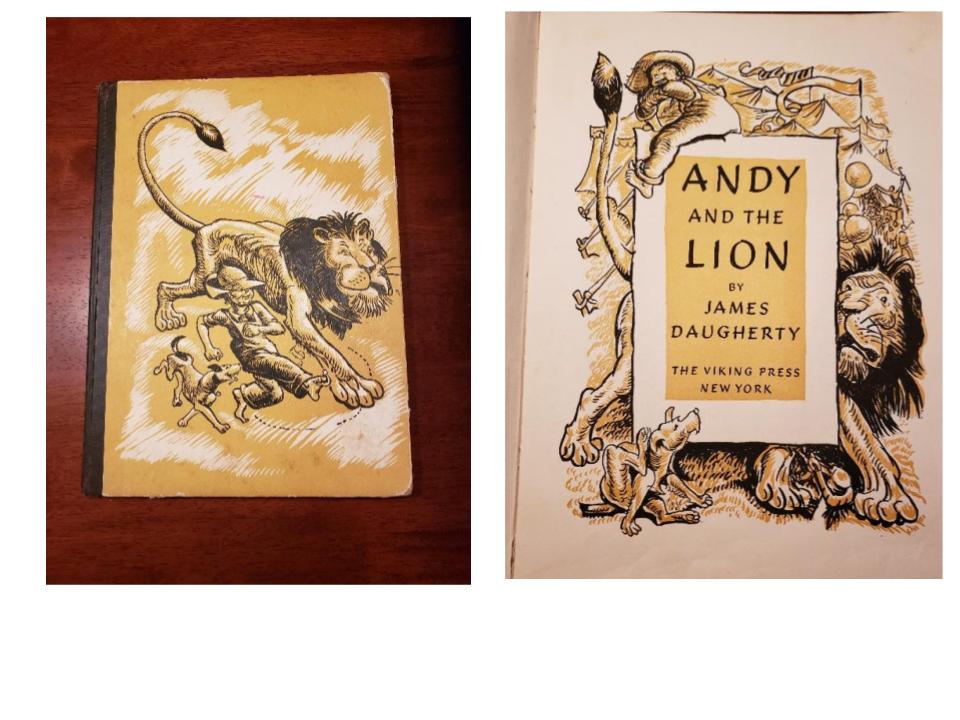
Left shows boy walking confidently alongside a happy lion in yellow, white and black. Right shows the title page of the book, which reads: Andy and the Lion by James Daugherty, The Viking Press, New York. Pictures around the title are a lion, young boy, and dog.
One of five Caldecott honor books in 1939, James Daugherty's Andy and the Lion takes a familiar fable and turns it into a heartwarming story about a child's dream come true. Daugherty's illustrations are fantastical but with enough realistic details to bring the story to life, making the story as much fun to "watch" as it is to read. For me, the brilliance of the book is that it works on many levels -- as a fable about kindness and gratitude, as a story about friendship, or as a testament to the power of books to ignite the imagination.

Noted children's book creator Lynd Ward summed it up well: "The book is gay [i.e., joyful] in its physical aspect where a yellow second color appears on every page and in its spirit of happy, carefree childhood, where fact and fancy combine into a world far more real than the prosaic pedestrianism of adult years" (Newbery Papers, p. 180).
 

Andy and the Lion:
A New Spin on a Familiar Tale 

Most of us are familiar with the fable about the suffering lion with a thorn in his paw who befriends the man who finally pulls it. In the original fable by Aesop, the the human is a slave names Androcles who escapes his master, where he meets the lion in the forest. After winning the animal's friendship, the two are captured, and Androcles is sentenced to death for running away -- specifically to be eaten by the lion. On the day of the execution, the lion refuses to eat his friend despite having been starved for several days; instead, the lion rejoices and licks the slave's hands. Shocked at this reaction, the emperor frees both Androcles and the lion. 

Subtitled "A Tale of Kindness Remembered or The Power of Gratitude," Andy and the Lion has a less grim context. Instead of slaves, emperors, and death sentences, we have a young boy who becomes fascinated by lions after a trip to his local library. In fact, he is so totally absorbed in reading and thinking about lions that he forgets simple, everyday things like washing behind his ears. Then, one day, he just happens to run into a lion on his way to school. After getting over the shock and confusion of this unlikely meeting, Andy sees that the lion is injured and helps him. The lion is grateful, and the two part ways -- that is until the circus comes to town. 

Andy, of course, will not miss the lion show at the circus for anything in the world, but to everyone's shock and horror, the biggest lion in the show escapes and he is in full lion fury. Chaos erupts and guards with guns rush to put down the escaped lion. Before they arrive on the scene, though, the lion rushes right up to Andy, and -- you guessed it -- recognizes his old pal! The two rejoice. Andy calls off the guards and leads the lion in a victory parade through town. The story ends with Andy and the lion together on a trip back to the library.

The story is as predictable as it is unbelievable, but like the fable that inspired it, it is ultimately shows good things happening to good characters -- and Daugherty's exuberant illustrations help us suspend our disbelief.

The "Interlocking Relationship Between Word and Picture" in Andy and the Lion

In the Biographical Note composed to honor his friend and colleague's Newbery award for Daniel Boone, Lynd Ward praises the innovation and technique that Daugherty exhibits in Andy and the Lion:

Any who are interested in the picture book technique as a form will do well to study the subtle nuances that have been worked out on these pages. The interlocking relationship between word and picture that is of the essence of this technique has here been carried several steps farther than I have seen in any other place, which is an event of importance in its own right (183).

Modern audiences might be perplexed at this praise. Compared to today's children's picture books, Andy and the Lion seems more dated that inventive with its three-color designs that typically appear every-other page. Moreover, the use of "cliffhanger" sentences  ("Andy thought he'd better be going and [. . .]) on several pages feels a bit contrived.

However, when we take the book in the context of 1938, Ward's point is much clearer. For example, take the spread where Andy pulls the dreaded thorn from the lion's paw. Here, we see the continuation of the text from the previous page (the thorn  . . . came . . . out) spread out on either side of the hyperbolic reactions of Andy and the lion to the action. The scene could easily appear in a picture book of today -- and nothing like it appears in the Caldecott books of the previous year.

Andy and the lion go flying to either side of the two page spread with Andy grasping the pulled thorn.

Another thing to notice the picture above is the movement; both Andy and the lion seem as if they will bounce of the page. Similarly, when the two meet and are chasing each other in confusion, Daugherty accurately captures the frenetic movement behind the lines "Whichever way that Andy ran -- there was the lion. Whichever way the lion ran -- there was Andy." In fact, we see in this picture a technique similar to what appears in cartoons even today:

Multiple overlaid images of both Andy and the lion going in different directions around a rock


One of my favorite things about the illustrations in this book is how Daugherty visualizes Andy's dreams. In the pictures below, we see Andy in the middle of the night, fully surrounded by his dreams about lions. On the right, the dream lion jumps behind the bed, while the sun smirks in the window. It's a humorous and fanciful depiction of waking up -- and yet it also captures something very true about the process for all of us. (I know that I have irrationally lashed out at my alarm as if it must feel some sort of spiteful glee interrupting my slumber...)
Two pictures: On left, Andy in the middle of the night, fully engulfed in his dreams about lions. On the right, the dream lion jumps behind the bed, while the sun smirks in the window.

The pictures not only enliven the text here but also reinforce the metaphoric language Daugherty uses to describe the end of the dream ("the lions left").

Daugherty's Blending of "Fact and Fancy" in
Andy and the Lion

While Daugherty's play with text and depiction of movement and imagination are among his top innovations in Andy and the Lion, it's the realistic details that he includes in each picture that ground the story. Among the best example of this are the expressions on the faces around the dinner table as Andy refuses to stop reading. The parents' outrage and annoyance is palpable but undercut by the oblivious glee that the baby exudes -- as well as the complete apathy of the sleeping dog who is obviously used to these family discussions. Meanwhile, Andy's pose, with his face almost on the page and his haphazard grasp on the fork, perfectly captures an engrossed reader:

Baby swings spoon in delight while mom points and scolds, father holds fork and knife upright giving a stern look while Andy reads at the dinner table, dog asleep at his foot.

This scene could be almost anyone's dinner table.

However, what really makes the illustrations magical for me is how Daugherty combines "fact and fancy" and Ward put it. A great example of this is on one of the front end papers depicting Andy reading with the lion at his feet. Despite the fact that we are seeing a boy with a pet lion, everything about the scene feels natural and normal:

Boy on big easy chair reading, feet on top of sleeping lion

May favorite example from the story is when Andy and the lion are reunited. I mean, I doubt that I will ever see a lion embrace a boy lovingly, but if I do, I am pretty sure that it will look like this:

Lion smiles with total joy, hugging young boy

The expressions and poses on both characters are perfection, and you can feel them dancing and spinning with joy.

A final example of this "fact and fancy" blending that I was to share is the spread introducing Part Two of the book. Here, Daugherty includes so many realistic natural details in the flora and fauna of the forest but in an almost surrealistic manner -- and the scene almost jumps off the page, both bursting with life and exciting our imagination. Like the forest animals on the left, we want to gaze ahead and see what happens next:
Young boy and dog march toward open fields and into the the sun from woods while forest animals look on


Reflecting on Andy and the Lion

On its Andy and the Lion story is a fun dream-come-true tale: A boy gets the lion of his dreams. It is also, as its subtitle suggests, story showing the rewards of kindness and gratitude -- and of course, it also reads as a classic story about true friendship, even between unlikely pairs.

However, I also think that you can see the book as a tribute to the power of books. After all, as the story opens, Andy us obsessively reading about lions and right before the main action, all that he read is swimming around in his brain. Perhaps the tale is what he imagines happening as he goes through his day -- and a testament to how much more magical our lives are thanks to the books that we read.

While I don't think it's necessary to read into the book so much, there are some details that make me think it's worth putting forth this second interpretation. First, the predominance of the library in the book is important, I think. The opening page dedicates the story to the lions outside the New York Public Library, and the story begins and ends with Andy going to the library. 
The emphasis on the library is interesting because it is not really necessary to the story: Andy could just as easily have been a kid who liked lions because of his grandfather's old hunting stories or because of a story he heard in school. So why include it in this tale about "the power of gratitude"?

I think the answer is found in James Daugherty's Newbery Acceptance Speech for Daniel Boone. Thanking the American Library Association for the award, he discusses the significance of libraries and librarians in his own life:

I always have a feeling of receiving a unique personal favor when borrowing books at libraries. I say to myself, how generous is this charming person to lend me, a perfect stranger, this valuable book, this priceless treasure. Or again, when returning it long overdue, I marvel at your charity, tolerance, and consideration. It revives one's shattered faith in humanity.
Therefore, I salute you not only as a counselor, guide, and friend, but more imaginatively in your magical powers to open doors into green pastures of knowledge and delight.

Clearly, Daugherty felt a tremendous sense of gratitude for everything libraries had given him, and I think it's possible that the story is an expression of this.


See more:


Featured Post

Boris Artzybasheff: The Book Artist

  ( Close up from Page 1 of  Let George Do It! --  a keepsake book issued by the American Institute of Graphic Arts to commemorate the speec...