About Me

My photo
I am a mother, educator, traveler, and reader with boundless curiosity.
Showing posts with label Helen Dean Fish. Show all posts

Tuesday, August 24, 2021

Four and Twenty Blackbirds, 1938 Caldecott Honor: A Slice of Past


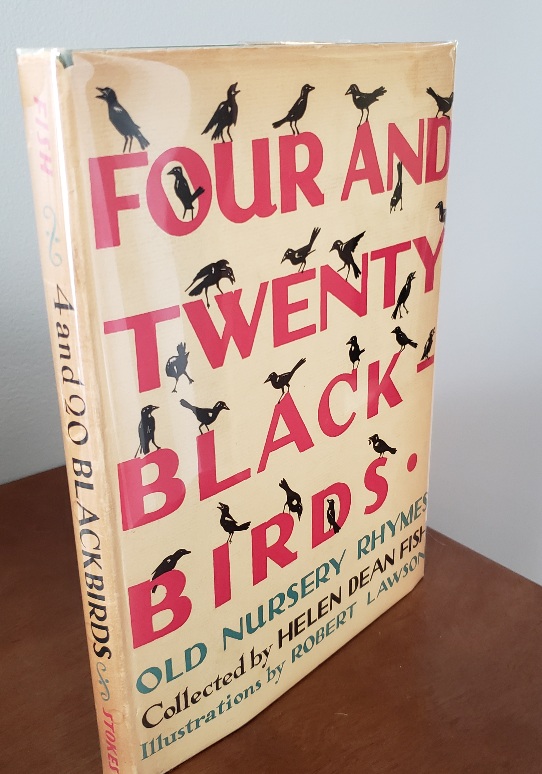
Book Cover

Despite it's title, 1938's second Caldecott honor book Four and Twenty Blackbirds: Old Nursery Rhymes is not your typical Mother Goose. Collected by Helen Dean Fish, who also assembled the year's Caldecott winner Animals of the Bible, it contains lesser-known jingles that would have been "old" even to readers in 1937. Using only black and green tempera, Robert Lawson (who also illustrated 1939 honor book Wee Gillis and the 1941 winner They Were Strong and Good) created 13 memorable full-page illustrations and several smaller sketches to help resurrect these old rhymes for new audiences. The big question is whether their "pie" will satisfy today's tastes. The answer probably depends on who's at the table.

Author Helen Dean Fish on Making Four and Twenty Blackbirds

And so, with Robert Lawson's invaluable support I have put these blackbirds into a pie before they have flown away forever, with the hope that when the pie is opened they will sing both lustily and sweetly for American children -- Helen Dean Fish, "Foreword" to Four and Twenty Blackbirds: Old Nursery Rhymes

As the above quote suggests, the author/editor of Four and Twenty Blackbirds viewed the work as something more than just a children's book. In detailing her efforts to compile this collection of the non-Mother Goose rhymes and jingles that she loved as a child, Helen Dean Fish establishes herself as a one-woman Brother's Grimm.  

By seeking out old texts, mining "the memories of older people," and comparing "literally hundreds of variants" of certain songs or stories, Fish gave us a book of 24 rhymes (or "blackbirds") that "have possibly been loved as genuinely as the shorter and more familiar Mother Goose Melodies" but are "in danger of being soon forgotten and lost forever." Fish was so committed to this historic preservation that she included music for several of the songs on the last five pages of the book.

As a student of history and lover of literature, I have to say that I appreciate Fish's tremendous effort; the "Caldecott Collector" and blogger in me feels a bond with her over our similar missions. As a writer, I also have to admire her confidence when she makes statements like this one: "The value of these old songs and rhymes is not likely to be questioned, I think, by anyone who has seen children enjoy them." Even if I thought that about my work, I doubt that I would ever have the self-assurance to say it, much less to write it. 

You just don't see that type of conviction every day, and at least in terms of the preservation of U.S. oral history, it's warranted. The nursery rhymes in this book are probably obscure to most readers; when I purchased my first copy of the book several years ago, I was shocked that aside from "The Little Red Hen," I only knew the title entry (which, surprisingly, does not even have its own "chapter" in the book, instead just being tagged to the end of the Foreword). I was a little familiar with "Frog Went A-Courting," but only because the 1956 Caldecott winner by Feodor Rojankovsky (author, John Langstaff). The remaining titles -- including "The Old Gray Goose," "Old Mother Tabbyskins," and "Rufflecumtuffle" -- had me mystified. So, right away, it seemed, this was not the typical book of nursery rhymes, and I was excited to explore it.


Illustrator Robert Lawson Helps the Blackbirds Take Flight

Aside from the unique focus of the collection, the art, of course, is what makes this book stand out. Robert Lawson's green and black drawings are sometimes  bold and dramatic, sometimes delicate and whimsical, and sometimes all of these and more.  A perfect example of this is Lawson's illustration for "Little Dame Crump," about an old woman who uses a found penny to purchase a pig that is reluctant to follow her home:

Lawson’s illustration captures a beautiful expanse of countryside, suggesting the long journey that the woman had to make to the market. While the bright green in the background pulls our eye to into the sweeping scene, small details in the forefront capture our attention. While Lawson takes great pains to draw the blades of grass shimmering in the shadow of the tree, the folds in the woman’s wrap, and the cobblestones in the street, he effectively uses whitespace to cast a spotlight on the tiny pig at the center of all the action. Anyone who’s walked a stubborn puppy will recognize -- and laugh at --  the pig’s pose and expression.

Another great example of this is the illustration for "The Famous Battle of the Bumble-Bug and Bumble Bee," where Lawson plays with perspective to give these two pests heroic proportions:

Giant beetle and bee atop a giant apple with tiny town in the background

Of course, while we might expect our two warriors to dominate the forefront, Lawson takes it a step further: Not only do the bugs outsize the tiny town in the background, but their size in comparison to the apple is as fanciful as their physical features are clearly delineated. 

Lawson's attention to detail extends beyond the natural world to the fantastic, as ween in his drawings for "Come Hither" and  "Rufflecumtuffle." The first of these shows a "good little boy" enjoying his horse, a reward that he received for learning his alphabet (after the house pets refused). There is s real sense of movement in the pose of the horse, and the feathers in the boy's cap seem to be blowing in the wind. The expression on his face, too, seems to be filled with awe; while literally this may be a reaction to the letters dancing around him, the picture seems to capture the idea that reading opens magical worlds.

Young man in a cape with feathered hat rides a horse through a giant letter "A" while other letters dance about.

Lawson creates another magical world for "Rufflecumtuffle," an elf who "longed to dance in the fairies' hall / For he knew he must outshine them all." The picture on the left shows a sketch of the title elf from the Table of Contents, while the picture on the right shows his three brothers heading over to the fairy hall intending to mock him:

Above, the title elf “was a real dandy / With whiskers flowing wide and sandy.”  To the right, his brothers in their tiny, turtle-drawn wagon. Notice the sly expression on the driver’s face and the mushroom-cap wheels.

As it happens, the faces of our studious "good little boy" and dancing elf are only two of the countless remarkable facial expressions that Lawson creates for both people and animals, giving both major and minor characters a palpable personality and adding interest to the text:

Animals and people with various expressions of humor, disbelief, concentration

My favorite of these expressions is on "Little Ren Hen." The tale teaches the value of hard work: Goose, duck, dog, cat, mouse, rat all refuse to help our heroine plant, tend, and reap the wheat, wanting only to eat the result. In the end, they rightfully lose out to the industrious hen's chick's, makin g this a very traditional story with a strong, traditional moral. Our heroine should feel content and satisfied, if not a little proud.

However, taking a look at the two depictions of our title character, we don't get a sense that she is whistling while she works. In the picture on the left, she almost seems to be spitting the wheat out, while in the one on the right, you can feel the weight of the sack, which we can only imagine would not seem quite as heavy to Dog or Cat. The feature that really stands out, though, is her face. Here, Lawson uses a natural feather pattern to accentuate her sharp eyes, and we can feel her frustration:

Although her efforts are rewarded, the Little Red Hen’s face reflects the annoyance and frustration we all feel when those around us refuse to do their fair share.

These depictions of the Little Red Hen are also two great examples of how some of the smaller art scattered throughout the book adds to the experience of the text. One of my favorite examples of this is the sketch of the idyllic little town that opens the "Merry Green Fields of England": 

Reflections on Four and Twenty Blackbirds

Not all of the pictures are as bucolic ad the last picture. Like other nursery rhymes and fairy tales of old, many of the rhymes and stories featured in this book deal with some dark themes. Two, in particular, center on death and the illustrations do nothing to hide this fact:
Top picture features a dead pig with its feet up in the air. Bottom picture features a dead goose in a similar pose.

Perhaps the "feet in the air" poses of the two animals were meant to be humorous and lighten the mood of the accompanying text. In "The Old Gray Goose," death is discussed rather cavalierly: Upon finding the dead goose, the singer simply plans to bury the animal in the morning and only somewhat laments the lack of goose eggs to eat in the future. By contrast, "Jim Findley's Pig" is much darker. After finding the pig dead in its sty, Finley's wife is so grief-stricken that she dies. All of this death pushes Finley to suicide: "The old man he died soon arter /He hung himself with his garter."

Darkness also pervades some of the cautionary tales. In "The Robber Kitten," the title character defiantly leaves his mother to "go and be a robber fierce/ And live in a dreary wood!" He immediately meets a rooster "And blew its head, with a pistol, off." Although the kitten eventually returns home after getting beaten by an older cat and a dog -- and seeing just how "bad" bad can be -- the "lesson" seems more rooted in a desire for self-preservation than an understanding of right and wrong. Lawson's artwork only underscores this darkness, as he chooses to illustrate the wayward kitten, not the enlightened one. His drawing for the tale is reminiscent of old cartoons and, as such may make them chuckle; however, for others it may seem a bit too graphic:

Kitten dressed in trench coat and fedora holding gun. Blast from gun obscures top portion of rooster. Flying feathers and bird claws.
I have laughed quite a bit at the violence in old cartoons like Tom and Jerry or Coyote and Road Runner. However, while those characters have a million lives, the death here was real. This fact and other events in the story, including the kitten going on a drinking binge with the dog, made me take the tale perhaps too seriously. 

"The Tragic Tale of Hooty the Owl" likely also was intended to inspire some  smiles and giggles, but also left me unsettled. Here, an owl sends a local hunter in the direction of the fox who ate his son. When the fox dies after putting up an extended fight, the owl laughs at his fate: "And the owl looked down from the branch overhead/ Where the lifeless, tailless fox lay dead, / And laughed aloud as away he flew, / 'Too-whit, too-whit, too-whit, too-whoo!" While I wanted to see the fox get his comeuppance for eating the owlet, laughing over a corpse seemed a bit too macabre.

Of course, maybe my reaction is more a critique of modern society. Taking risks, like running away from home, can lead to real danger. Vengeance can transform a victim into a villain. Violence is, after all, violent. No one would argue these points, and yet we shield children from these truths by creating cartoons and action movies with characters that often survive impossible circumstances -- or by sanitizing these ideas to a point where they barely resemble the lessons that they are meant to show. 

Who is doing more harm? It's an interesting question to ponder as we think about rising numbers of children's mental health issues in today's world and wonder if that's due to our actions, changes in our social fabric, or simply greater awareness of problems that always existed.

If the violence in some of these rhymes doesn't goes too far for you, some of the male chauvinism might. Given the fact that this book was written in 1938 and attempted to preserve an oral tradition dating back even further, I expected rhymes such as "Joe Dobson." In this jingle, a man brags he can outdo his wife with the house chores. She takes him up on the challenge, but he is overwhelmed by her everyday tasks and thwarted by the farm animals: "Joe suddenly confessed/He was convinced that wives could do/ The household business best." Honestly, aside from the last three lines, it's a rather funny rhyme and easily seems the stuff any sitcom in which people trade roles.

The same cannot be said for "Mr. Bourne and His Wife." In the rhyme, the title characters get into a fight over bread, toast, and butter. Their neighbor "overhear[s] the splutter" and attacks Mr. Bourne, saying, "'By my life, / You shall not beat your wife! / It is both a sin and a disgrace!'" In return, Mrs. Bourne attacks him and sends him running. The listener is cautioned not to poke "his snout in" if  "married folks are flouting." My guess (hope?) is that the scenario is a humorous dramatization of more nuanced disagreements and interference --  and thankfully Lawson's illustration (below) supports this interpretation. However, given the language, it really just seems to advise looking the other way in cases of spousal abuse.

Man running from doorway with pans and kitchen items being thrown at him.

While I truly believe that it is important to read older works in the time period of their era and not be overly critical of them in light of modern standards and tastes, I do think that I would have great difficulty reading or singing many of these rhymes to a child -- particularly one at a "nursery rhyme age." Just as I cannot change the time period in which these rhymes developed and were recorded, I also cannot change the time period in which I grew up and now live. 

Still, I am glad that someone took the time to preserve these rhymes. Not only does it give us a sense of what life was like "back then," but it also gives us a new lens through which we can view our own cultural perspective. The book also proved a wonderful vehicle to experience the art of one of the great children's illustrators, Robert Lawson, who does more in two colors than many can accomplish with a full palette. 

Thus, as the book's creator, Helen Dean Fish predicted, I am "not likely" to question "the value of these old songs and rhymes." However, for me at least, times have changed too much for children to "sing both lustily and sweetly" many of the songs in this book. Whether this legacy would be enough for Fish is a question that must remain unanswered.


Monday, August 9, 2021

Animals of the Bible, 1938 Caldecott Winner: In the Beginning, There Was . . .


Illustrated by Dorothy P. Lathrop, Animals of the Bible: A Picture Book is exactly what it says: a compilation of several Old and New Testament passages that feature animals, with accompanying illustrations. It was assembled by Helen Dean Fish, who also compiled one of 1938's runner-ups (now called Honor Books), Four and Twenty Blackbirds: Nursery Rhymes of Yesterday Recalled for Children of Today.

Although today there likely would be controversy about giving a national arts award to a book consisting almost solely of biblical verses straight out of the King James, the writer in me appreciates the symbolism of the first Caldecott gold going to a book that opens with the Story of Creation. Granted, there are other versions of this tale from non Judeo-Christian sources that might make wonderful picture books for children and have the same symbolic effect. However, I am not sure that any of them were published in 1937, and although someone could write a dissertation on the cultural or socio-political reasons underlying the biblical focus of this book --and its selection to win the very first Caldecott in 1938 -- that's a bit outside my focus.

About Animals of the Bible

The 66-page book features 27 black and white lithographs by Dorothy P. Lathrop and 40 Bible passages selected by editor Helen Dean Fish. The layout of the book makes it easy for those already familiar with -- or not at all interested in -- the Bible verses to focus on the illustrations.

In her forward to the book, Fish notes that Lathrop painstakingly "studied not only the fauna but the flora of Bible lands and times, and each desert rose, as well as each goat and turtle dove is as true to natural history as is possible to be" (Animals, vi).  From what I have read about Lathrop, this level of detail is a hallmark of her art. As her sister, Gertrude, noted: 

She has never wanted to draw down to a child, giving him only the crude outlines which are all that he, with his limited experience and skill, is capable of producing . . .She has always felt that a child with his fresh vision sees more detail than we any longer remember to observe . . .The greatest compliment, my sister says, that she ever received was when a child, looking at a drawing of one of these little squirrels, reached out and stroked the picture fur (Horn Book II, p. 20). 

Below are two drawings from Animals that capture this sense of detail and texture:

“The Foxes Have Holes,” accompanying Matthew 8:19-20.  Both of these guys seem so fluffy and touchable that it’s easy to miss the crags in the tree roots or the veins in the leaves of the plant. Everything in this excerpt from the picture seems connected, making it a fitting example of what Lathrop asserts in her acceptance speech:  No one, I think, is more convinced of the unity of all life than the artist, who sits before its different phases so long and silently, seeing them in a great intimacy. He not only beholds the flower, but he feels the life that, even while he draws, unfolds the petals, senses the force that pushes new life from the ground (Horn Book II, p. 11).

“God’s Care of the Animals,” accompanying Psalms 104:10-12, 16-28, and 31, on page 36.   This is one of my favorite illustrations from the book. Another example of the “unity of all life” that Lathrop felt and wanted to convey, it also shows the care Fish stresses that she took to study the landscapes and fauna.  I really appreciate Lathrop’s attention to detail here, as well as her ability to create texture and mood. In particular, you can almost feel the bristle on the manes of the “wild asses, the rough edges of the rock, the cottony fur of the mountain goats, and the smooth feathers of the stork. I especially love how Lathrop was able to capture the water: the varying reflections, the rippling caused by the animals’ tongues, the little pools around the stork’s legs. The effect is one of complete peace and tranquility, which beautifully reflects the Psalms that they depict.


Dorothy Lathrop's Artistry in Animals of the Bible

In terms of mood, another favorite picture of mine is the illustration for "The Story of the Creation of the Animals" on pages 2-3.  The expressions on the animals' faces (especially the monkey, antelope, and elephant), their posing, and the arrangement all create a feeling of chaotic exuberance without any sense of fear or anxiety.


While the focus of the book is on animals, the more I study it, the more I appreciate Lathrop's ability to depict people. Three pictures particularly stand out.  First, is "Abraham's Ram," accompanying Genesis 22:3-13, on page 13. The first thing I noticed was the sheer terror on the faces of Isaac and the ram, which I would expect from anyone realizing that they were about to be sacrificed. However, I also have come to appreciate the depiction of Abraham. The sadness in his eyes and a weakness in his grip, subtly conveyed by the shadow between his hand and the knife, that contrast markedly with the tightness in his jaw. You can feel him drumming up the resolve and courage to carry out God's command:

My two other "favorite faces" are below. First is "The Palm Sunday Colt," accompanying Mark 11:1-9 on page 59. The sense of awe on the faces of the woman and girl peering through the palms is palpable; the woman almost looks as if she is going to cry. At the same time, Jesus exudes peace, a feeling that actually seems to have completely enveloped the animal carrying him to his fate. The second picture accompanies the story of Peter's denial of Jesus from Luke 22:54-62 on page 63. His expression shows the self-loathing and anguish that he feels upon hearing the rooster crow and realizing that Jesus's prophecy has come true.

My final "favorite" to spotlight is "The Flocks of Christian Shepherds," illustrating Luke 2:8-20, on page 47.  Yes, the angel seems to glow on the page (and not just because of the reflection of my desk lamp). Yes, you can almost feel the spongy wool of the sheep's fleece. Yes, the movement of water seems to ripple over the page and you are swept up in the the wonder of the shepherds. All of that is true, but what I especially love about this drawing is the assortment of reactions from the animals. Two sheep on the left are looking up in awe; surrounding them, however, one goat has his eyes half-closed as if he is falling asleep. Another sheep seems to be looking past everything at something in the distance that I suppose is more interesting to it than the heavenly visit. In the forefront, two are looking away without any sense of fear, maybe just wondering why the water is so bright now, and another is drinking without a care for this giant angel come down to Earth. 

The whole scene is as whimsical to me as it is wondrous. I can't help but wonder if Lathrop was having as bit of fun here as well, since the picture seems to reflect her tongue-in-cheek description of what it's like to work with animals:

In such an illustrator's studio, what conversation there is is strictly one-sided, except for an occasional squeal of protest from a model prodded too often into the semblance of a position taken spontaneously just once. And on the illustrator's side also it is limited and repetitive to a pitiful degree, consisting almost entirely of such ejaculations and pleas as, "Hold still! Please hold still! Just for one little minute! For a second then! That's it! Oh dear!" Not that such conversation is of the slightest use . . .But animals when they pose, make no bones about their sleepiness. In fact their bones seem to turn to water.  Stand them up, and like a child in a tantrum, they don't stay stood up .  .  . Just now, my model is a baby flying squirrel. Since he has posed from the time he was pink and hairless -- though I hasten to add for the S.P.C.A. that those early poses could only have been measured in seconds -- he ought by now to be an experienced model. But he goes to sleep on the job. And his cradle is, most inconveniently, my left hand! Until deprived of it, I never realized how much I used it while drawing (Horn Book II, pages 8-9).

While I enjoyed this picture from the start, Lathrop's acceptance speech made it even more enjoyable.  I just picture her trying to get another "awed" expression from a slightly different sheep, coaxing them with "nibbles of graham crackers and rubbing behind the ears," coming close, and then desperately crying, "Oh dear!" only to eventually resign herself, "Well, that will have to do." After all, she says later in connection with her depiction of the fantastical Leviathan: "[I]f publishers were not always in such a hurry for drawings, and there were no such thing as publication dates, I suppose I night still be sitting, pencil in hand, on the seashore hoping for a glimpse of 'that great serpent of the deep" (Horn Book II, p. 14). Likely, she would still be waiting for that perfect pose as well.


Reflections on Animals of the Bible

I started my tour of this book wondering, as so many others online do, whether it would receive the same accolades today as it did in 1938. I think that it's safe to say that it likely would not, due primarily to the subject matter but maybe also to changing tastes and standards as well. Nevertheless, there is a beauty and personality that Lathrop was able to capture that feels timeless to me, and the more time I spend with it, the more I find myself marrying the words to the pictures and reflecting on how those events from the Bible actually felt. Maybe that's what the members of the selection committee saw as well.

Want to see more about the book and its artist?  Check out my other posts:


Dorothy P. Lathrop, 1938 Caldecott Artist: One with Her Art


Although I have not been able to find the same amount of information that is available for some other Caldecott artists, I have uncovered enough to paint a pretty clear portrait of Dorothy Pulis Lathrop (April 16, 1891-December 30, 1980). Aside from winning the 1938 Caldecott for Animals of the Bible: A Picture Book, she was and artist and activist who expressed her love of nature through her art -- and while from the outside it may seem as if she mostly lived apart from the world, her work is really an expression of her feeling of oneness with it.

Who was Dorothy Pulis Lathrop, Illustrator of the First-Ever Caldecott Gold? 


Internet search after Internet search is likely to reveal little more than what appears in The New York Times's 126-word obituary.

The brevity of the notice shocks me because the NYT seems able to make a story out of just about everything, so the fact that it only provides her age (89), her Caldecott accomplishment, her survivor (her sister Gertrude), her occupation, and educational background suggests that there are not many additional facts. Wikipedia's biography for her is only a bit more than twice as long as the NYT story, although it is at least accompanied by a 51-title bibliography, as well as some examples and links to her art, which is included in permanent collections at the Metropolitan Museum of Art, William College Museum of Art, and the Huntsville Museum of Art. The biography also gives a little bit of detail on her successful partnerships with Walter de la Mare and Rachel Field, and notes that she was elected to the National Academy of Design in 1949. BrainPickings shows several examples of the results of her partnership with de la Mare, and more examples are available via WikiArt.

Likely, this lack of detail is partly why 50 Watts Books included her in the "Forgotten Illustrator" series, and the page devoted to her has some fantastic examples of her art -- as does the JVJ Publishing page devoted to her work. JVJ also has links to her acceptance speech and her sister Gertrude's biographical paper, both of which were published by Horn Book in Caldecott Medal Books: 1938-1957 (Eds.: Bertha Mahony Miller & Elinor Whitney Field).  

Dorothy Lathrop as a Person and an Artist

Although the amount of biographical details available for Lathrop pale in comparison to what we are used to today for even people of minor note, there is enough in the available documents, I think, to give a strong sense of Dorothy Lathrop's character. 

As JVJ notes, "Her mother was a painter, her grandfather owned a bookstore, and her sister, Gertrude, was a sculptor, so she seemed destined for a career in art and literature." This seems true from the details that both she and her sister provide. Gertrude describes her sister as a fanciful and somewhat fearless child who loved nature, believed in fairies, and "often looked through her small magnifying glass at a miniature flower, its detail too minute for the unaided human eye to see, and marveled as the high-powered lens revealed a beauty and perfection as lovely as any orchid." 

While their mother's "enthusiasm and reverence for all things beautiful" seems to have dominated Lathrop's childhood, her father's practicality and mistrust "of art as a means of earning a living" won out at least temporarily, and she spent three years at Columbia Teacher's College and another at the Pennsylvania Academy of Fine Arts. She spent two years teaching art at Albany High School when another teacher's "crisp" remark -- "'You would be here if you could [draw like that]'" -- prompted her to take her chances as an illustrator. She eventually got a commission, but the publisher went bankrupt before she got paid.

After that, Knopf selected her to illustrate Walter de la Mare's The Three Mulla-Mulgars, and an illustrator was born. She also illustrated Rachel Field's Newbery-winning book Hitty: Her First Hundred Years as well as her own The Fairy Circus, a Newbery honor book in 1932. In fact, her sister notes that Dorothy authored several of her own books and "took all the English and writing courses offered" during college. Among her self-authored books is the 1951 Let Them Live, which her sister describes as an advocacy piece to protect "the creatures so hard pressed in a world which men feel belongs only to them." The passion Dorothy felt for this cause is beyond doubt, apparent even with a quick read of this book, which details the habits of more than 20 different animals as well as the contributions each makes to the ecosystem and the ways each has been affected by humans.

Orange book cover featuring spotted fawn, birds, fox, rabbit in the upper left corner. Other pictures are black-and-white drawings of: Crow feeding its baby, badger, two ibises walking through reeds, praying mantis in a flower, coyote howling at the moon, two beavers building a dam, baby seal nuzzling its mother.

As Lothrop recounts the effects of everything from hunting for profit to agriculture, it is difficult to distinguish her main points from those of today's conservationists and environmentalists, all of whom would likely agree with her conclusion:

For all of us are earth creatures and all must live here together. We are the strongest. It is in our power either to destroy or protect the weaker ones. We have destroyed without mercy. Let us now protect with out strength those creatures that are left, and save their food, their homes, and their lives from those who would selfishly take all these away. For each creature loves its life as we do ours, It loves the earth and the sun and each new day.

We must let them live or we shall be alone in a silent world, and lonely for the singing of birds and the flash of their wings, for the chirping of insects and the swift running of wild feet.

Together with her sister's recollections, these words suggest a strength and conviction that belies the rather sheepish opening to her Caldecott acceptance speech: "I can't help wishing that just now all of you were animals. Of course, technically you are, but if only I could look down into a sea of furry faces, I would know better what to say." Similarly, her recollections of the "repeated conferences with my editor while the book was being made" show something of the rebel. "I must have been a most ferocious child," she muses, "for those stories that were my special delight are much too dreadful to be given to children of the present day." Among these are the bears who devour the children who jeered at Elisha, the Gadarene swine, and Samson's "foxes with the burning brands tied between their tails." 

I am sure that Lathrop was too smart and sensitive to believe that a children's book was going to feature such things -- and part of me wonders if such conversations even really took place. Nevertheless, Lathrop uses the conversation, whether real or fictional, to make a larger point about the violence to which children are exposed: "Who would have believed that those young beings whose weekly fare is the animated cartoon in which great wolves with wide open mouths and dripping jowls tower in relentless pursuit like the nightmare creatures of delirium until the blot out all else and engulf at least even the beholder -- who would have believed that those children would blench at the story of Elisha's two she-bears?"

Getting to Know Dorothy Lathrop Through Animals of the Bible

In discussing the animals that did make it into the Animals of the Bible, Lathrop cites only a few, and I think her commentary reveals a gentle soul and quirky sense of humor:


“The Family Dogs,” accompanying Matthew 15:21-28, on page 53.  From Lathrop’s acceptance speech:   Children feel a natural kinship with a;; living things. It is we adults who alienate them . . . Perhaps in Animals of the Bible I have taken a liberty in introducing children into the picture of the family dogs. But I felt sure that, though no children were mentioned in the text, where the dogs were, even in those ancient days, the the children would be also, and helping them to more crumbs than those which normally fell from their master’s table. For there is a special link in all ages between children and animals. . .  (Horn Book II, pages 12-13).


“David Saves His Sheep from a Lion and a Bear,” accompanying 1 Samuel 17:32-37.  From Lathrop’s acceptance speech:  Nevertheless, my editor was firm and I had to draw instead the bear which David slew, and draw him chasing a lamb. The I was as sorry for the lamb as she was for the rude children who jeered at the prophet’s bald head, and sorrier still yet for the bear, which she didn’t understand at all.

“The Scapegoat,” accompanying Leviticus 16:8-10, 21-22, on page 17. “Balaam’s Ass,” accompanying Numbers 22: 21-34  From Lathrop’s acceptance speech:  I wish that I had found the scapegoat when I was a child. I know that I would have rejoiced with him that it was his lot to be let go in the wilderness. For there seems to have been no Kindness to Animals Week in those ancient days. Though the pages of the Bible are filled wit casual references to beasts as possessions, as fioid, as victims of sacrifice, I can remember no one who objected to any mistreatment of them except the angel who stood in Balaam’s path. . . (Horn Book II, page 14).


“Leviathan,” accompanying Job 41:1-5, 9-10, 13-34, on page 29.  From Lathrop’s acceptance speech:   No present-day naturalist could describe an animal more minutely than leviathan is there [in Job] presented, scale by scale, and surely none could portray one with such grandeur. “He maketh the deep to boil like a pot: He maketh the sea like a pot of ointment . . . By his nessings a light doth shine, and his eyes are like the eyelids of the morning.” It was lucky that the description was so detailed, for no leviathan visited our shores to pose for me (Horn Book II, page 14).

“The Ravens Who Fed Elijah,” accompanying 1 Kings 17:1-6.  From Lathrop’s acceptance speech:  Not all -- by any means -- if my favorite stories were left out of this book. In fact, most of them are in, including that of Elijah and the ravens. But not until I sat down before some caged ravens in the zoo did I realize that they have brains of more than a birdlike sort, and that is probably why they were chosen above other birds to feed Elijah in the wilderness. For there they were, whiling away the hours of their confinement by playing with anything they could find in their cage, tossing and twirling and carrying about . . .They eyed me wisely, too, and answered when spoken to. Perhaps Elijah was not, after all, too lonely in the wilderness (The Horn Book II, page 15).

Lathrop closes here discussion of the book by discussing the closing image and passage: 

For the sake of the child that I was, who wanted the foxes to escape the fire, and who hope that the hungry lions would be fed, though not with Daniel, and for the sake of all other children who love and cherish animals -- and are there many who don't? -- I am glad that we ended the book with the prophecy of Isaiah: "The wolf shall dwell with the lamb, and the leopard shall lie down with the kid; and the calf and the young lion and the fatling together; and a little child shall lead them . . . They shall not hurt or destroy in all my holy mountain: for the earth shall be full of the knowledge of the Lord, as the waters cover the sea" (Horn Book II, page 15).
Small child surrounded by a lion and leopard, while a baby bear, lion, lamb and calf play. The leopard is cuddling a baby goat.

Although intended to depict Isaiah 11:4-9, the image could just as easily illustrate the "unity of all life" upon which Lathrop meditates for much of her acceptance speech -- a kinship with the world that she seems to have felt deeply: 

In that deep silence in which drawings are made, [the artist] so projects himself into the personality of any living model before him, that he becomes strangely identified with it. He not only feels himself brother to this creature whose atoms are held together by the same mysterious force or vibration, not only feels the same life surging through them both, but such is his intensity of interest, he becomes that creature. Or, as the eastern philosophers put it, he "sees all creatures in himself, himself in all creatures (Horn Book II, page 11).

With these words in mind, perhaps everything knowable about this wonderful artist is right there before us in the works that she left behind.


Featured Post

Boris Artzybasheff: The Book Artist

  ( Close up from Page 1 of  Let George Do It! --  a keepsake book issued by the American Institute of Graphic Arts to commemorate the speec...