About Me

My photo
I am a mother, educator, traveler, and reader with boundless curiosity.
Showing posts with label Caldecott. Show all posts

Tuesday, October 19, 2021

They Were Strong and Good, 1941 Caldecott Winner: Unintended Consequences

 Book cover. Red dust jacket has four gold portraits of people from the 19th century outlined in gold. In the forefront is a two-sided frame opened with more detailed portraits in black against a gold background. Title appears in large white letters. Author's name in black ink

With America on the brink of a war that the rest of the world was embroiled in, it is not surprising that ALA would bestow its 1941 Caldecott gold on a book that celebrated America. Both the title and text of They Were Strong and Good unabashedly assert author and illustrator Robert Lawson's purpose: to tell the story of his parents and grandparents, and in so doing, pay tribute to the ordinary people who helped build an extraordinary nation. As he stated in a speech to the Cleveland Library Association in 1940:

Now about this book They were Strong and Good. Lots of people have asked me why I wrote it-- it hasn't much story. It is just a simple account, mostly in pictures, of my mother and my father and their mothers and fathers, my grandparents. But it is pretty much the story of your parents and grandparents too. None of them were great or famous. It doesn't matter whether they were see captains or preachers or cowboys or farmers or hardware merchants or just good mothers. They were the simple, ordinary people of the generations before us who worked hard and were strong and good and who each in his own small way helped to build up this great country out of a wilderness. They have turned all this over to us and it is up to us to keep it a great nation. I have hoped that just presenting a simple picture of some of these people would give to the young people of this time and perhaps to their parents a feeling of pride in their country and their forefathers and a feeling of greater responsibility. Right now our country could do with a lot of both. I hope that this book will cause some of the young people of today to look back and think about what they did, these parents and grandparents and great-grandparents of our, and to think about what we haven't done and to feel, as I do, a little ashamed of ourselves and to decide to do something about it, to be a little more worthy of them (Lawson, Cleveland Library Speech).

Such a pointed message was a new milestone for Lawson. He was well established as a children's book artist, having been a Caldecott runner up twice before -- in 1939 for Wee Gillis and in 1938 for Four and Twenty Blackbirds: Old Nursery Rhymes -- as well as the illustrator for the 1936 smash hit The Story of Ferdinand. However, his most popular works thus far had been noted for their humor, with enjoyment as their main purpose. Now that he had both critical and commercial success, he had earned the freedom not just to pick his own projects but to originate them as well -- and he was not afraid to use it.

Given this background, you might see this book and heave a sigh as you open it, preparing for an onslaught of traditional patriotic preaching. Even the cover, with its staid portraits and red-gold flourishes, makes you think that this book will be will be a dated and forgettable experience.

Nothing could be further from the truth -- although admittedly, the book will make an impression of different people for different reasons.

Although Lawson makes his purpose known in the Foreword to the book, the message is quite short and not nearly as heavy-handed as the speeches he gave about the book. Instead, like any good storyteller, he is quick to just get on with the action -- or in this case, to give brief accounts of the lives of his grandparents and parents. 

Each account is simple but lyrical, and Lawson chooses to focus on events that underscore the humanity of these people -- strangers to us and (at least in the case of his grandparents) distant from him. Of course, this being a Caldecott book, the exquisite artwork brings these tales fully to life.

Thus, we see his grandfather, a swashbuckling Scott, almost felled by a parrot and then smitten by the demure Dutch girl he happens upon at port. Their intense romance is only suggested, and cut short by the bride's seasickness on the way to their Caribbean honeymoon. Note the humor that the parrot brings, first undercutting the Scott's proud strut by climbing the crewman's hat -- and the pandemonium that ensues when he eats a hat; the monkey's shocked look says it all.

Picture 1: Portrait of the black-haired Scott with a low beard and no mustache in a 19th century suit with a bowtie. Picture 2: The same man, tall and dressed finely, strutting through a market with a crew member being attacked by parrots and an African American boy carrying a board and goods on his head while monkeys climb. Picture 3: The man holds a scrap of material , yelling at the parrot which is in flight. The monkey gapes in horror.

I love the smile that his mother's mother makes while his grandfather is talking to her in the wagon. It perfectly captures that flirtatious mood when you are cautioning yourself against taking a person too seriously but also hoping that they mean what they're saying.

Picture 1: Serene looking woman with a tuft of blond hair sticking out from under a white headscarf. Picture 2: A covered wagon,. Picture 3: Woman sits with her eyes closed in the wagon, smiling as a dark-haired bearded man talks to her. Picture 4: Woman hanging over the edge of a boat with rough waves.

We also see the young couple, both sick of the sea, move to Minnesota, where life proves a bit too rough for their gentle daughter, Lawson's mother, who attends a convent school where she learns, among other things, how to charm bees. Notice in these pictures how Lawson captures the raucousness of the Minnesota lumberjacks, and the horror on his mother's face -- and how just a few pages later, he creates an almost Eden-like world.

Side-by-side pictures of a dark-haired girl.  One, a teenager, lifting a beehive next to a nun without getting stung. The second is the same girl, younger, walking hand-in-hand with an unseen man (probably her father) with rowdy lumberjacks in the background. Girl's expression is one of shock.

We see his other grandfather "always fighting something," be it Satan or Yankees, and can tell from his expression that he was never at peace -- while the distant profile of his father's mother and brevity of her tale make us wonder if that fighting spirit took its toll on her. It's a glaring reminder that everyone's family has untold stories.

Side-by-side portraits two dark-haired people. She is in profile with shiny hair, eyes gazing into the distance; she wears and elaborate ruffled collar with a large necklace. He has wild hair and a stern look.

Finally, we see his father, who went off to war at the age of 14, where he got "not much of a mule" but "he was not much of a man." That would change as he taught himself to endure the suffering of battles and diminishing resources with honor -- and later to embark on a new life in New York City.


Portrait features a man with wavy dark hair and a long mustache in a cravat. Other pictures show him as a youth. One hunting with an African American boy and two dogs, another standing by a cannon in tattered clothes with a tattered flag. The next shows him almost as a silhouette walking through a destroyed town. In the final, he is a suited young man leaning over a dark-haired young woman in a gown, trying to get her attention.

Thus, Lawson provides plenty of details to help the reader connect with these ordinary people of the past. However, for modern audiences, several of these details also may make such connections impossible. The depictions of African Americans and other nonwhites, two of which appear above, have been called cliched and stereotypical, and in a few places, Lawson's language doesn't help matters. He refers to the Native Americans where his mother grew up as "tame" (wording that I believe was later changed) and makes a point of saying that his mother feared them. Readers today also may cringe (I did) at the matter-of-fact way that he writes of his father "having" Dick, a slave -- listed as a possession after his two dogs.

Such an approach clearly (and rightly) would draw criticism today -- as would Lawson's assertion that the story of his family is "pretty much the story of your parents and grandparents too." I know, for example, that it is not the story of my parents and grandparents. Far from it. And it is not the story of countless other Americans who built, and continue to "build up this great country"  (Lawson, Cleveland Library Speech).

With all of this in mind, the impact of this book depends entirely on the individual reader -- more so than most. While some will no doubt revel in its traditional patriotism, others will reject it as a not-so-subtle example of racism in children's books from a previous era. For myself, I think the book does a very good job of creating some memorable artwork and showing the humanity, however flawed, of people from a different age. I also think it could prove a useful tool to have discussions about prejudice, racism, and changing social mores -- conversations that we desperately need to start having and not shying away from. While that may not be the legacy that Lawson intended for They Were Strong and Good, I believe that it might be an even greater gift than he realized.

Lawson, R. (1940). “Cleveland Library Speech 1940.” Free Library of Philadelphia, Frederick R. Gardner Collection of Robert Lawson, Box 39, Folder 35.
For More on this Book & Artist, see:

Monday, September 6, 2021

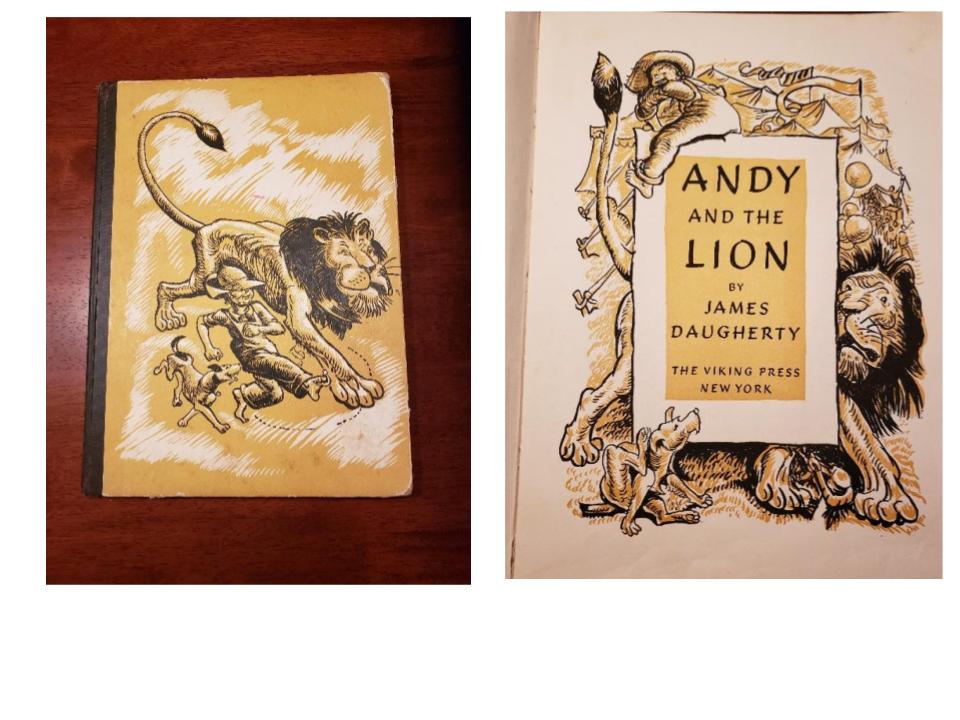
Andy and the Lion, 1939 Caldecott Honor: Combining "Fact and Fancy"

Left shows boy walking confidently alongside a happy lion in yellow, white and black. Right shows the title page of the book, which reads: Andy and the Lion by James Daugherty, The Viking Press, New York. Pictures around the title are a lion, young boy, and dog.
One of five Caldecott honor books in 1939, James Daugherty's Andy and the Lion takes a familiar fable and turns it into a heartwarming story about a child's dream come true. Daugherty's illustrations are fantastical but with enough realistic details to bring the story to life, making the story as much fun to "watch" as it is to read. For me, the brilliance of the book is that it works on many levels -- as a fable about kindness and gratitude, as a story about friendship, or as a testament to the power of books to ignite the imagination.

Noted children's book creator Lynd Ward summed it up well: "The book is gay [i.e., joyful] in its physical aspect where a yellow second color appears on every page and in its spirit of happy, carefree childhood, where fact and fancy combine into a world far more real than the prosaic pedestrianism of adult years" (Newbery Papers, p. 180).
 

Andy and the Lion:
A New Spin on a Familiar Tale 

Most of us are familiar with the fable about the suffering lion with a thorn in his paw who befriends the man who finally pulls it. In the original fable by Aesop, the the human is a slave names Androcles who escapes his master, where he meets the lion in the forest. After winning the animal's friendship, the two are captured, and Androcles is sentenced to death for running away -- specifically to be eaten by the lion. On the day of the execution, the lion refuses to eat his friend despite having been starved for several days; instead, the lion rejoices and licks the slave's hands. Shocked at this reaction, the emperor frees both Androcles and the lion. 

Subtitled "A Tale of Kindness Remembered or The Power of Gratitude," Andy and the Lion has a less grim context. Instead of slaves, emperors, and death sentences, we have a young boy who becomes fascinated by lions after a trip to his local library. In fact, he is so totally absorbed in reading and thinking about lions that he forgets simple, everyday things like washing behind his ears. Then, one day, he just happens to run into a lion on his way to school. After getting over the shock and confusion of this unlikely meeting, Andy sees that the lion is injured and helps him. The lion is grateful, and the two part ways -- that is until the circus comes to town. 

Andy, of course, will not miss the lion show at the circus for anything in the world, but to everyone's shock and horror, the biggest lion in the show escapes and he is in full lion fury. Chaos erupts and guards with guns rush to put down the escaped lion. Before they arrive on the scene, though, the lion rushes right up to Andy, and -- you guessed it -- recognizes his old pal! The two rejoice. Andy calls off the guards and leads the lion in a victory parade through town. The story ends with Andy and the lion together on a trip back to the library.

The story is as predictable as it is unbelievable, but like the fable that inspired it, it is ultimately shows good things happening to good characters -- and Daugherty's exuberant illustrations help us suspend our disbelief.

The "Interlocking Relationship Between Word and Picture" in Andy and the Lion

In the Biographical Note composed to honor his friend and colleague's Newbery award for Daniel Boone, Lynd Ward praises the innovation and technique that Daugherty exhibits in Andy and the Lion:

Any who are interested in the picture book technique as a form will do well to study the subtle nuances that have been worked out on these pages. The interlocking relationship between word and picture that is of the essence of this technique has here been carried several steps farther than I have seen in any other place, which is an event of importance in its own right (183).

Modern audiences might be perplexed at this praise. Compared to today's children's picture books, Andy and the Lion seems more dated that inventive with its three-color designs that typically appear every-other page. Moreover, the use of "cliffhanger" sentences  ("Andy thought he'd better be going and [. . .]) on several pages feels a bit contrived.

However, when we take the book in the context of 1938, Ward's point is much clearer. For example, take the spread where Andy pulls the dreaded thorn from the lion's paw. Here, we see the continuation of the text from the previous page (the thorn  . . . came . . . out) spread out on either side of the hyperbolic reactions of Andy and the lion to the action. The scene could easily appear in a picture book of today -- and nothing like it appears in the Caldecott books of the previous year.

Andy and the lion go flying to either side of the two page spread with Andy grasping the pulled thorn.

Another thing to notice the picture above is the movement; both Andy and the lion seem as if they will bounce of the page. Similarly, when the two meet and are chasing each other in confusion, Daugherty accurately captures the frenetic movement behind the lines "Whichever way that Andy ran -- there was the lion. Whichever way the lion ran -- there was Andy." In fact, we see in this picture a technique similar to what appears in cartoons even today:

Multiple overlaid images of both Andy and the lion going in different directions around a rock


One of my favorite things about the illustrations in this book is how Daugherty visualizes Andy's dreams. In the pictures below, we see Andy in the middle of the night, fully surrounded by his dreams about lions. On the right, the dream lion jumps behind the bed, while the sun smirks in the window. It's a humorous and fanciful depiction of waking up -- and yet it also captures something very true about the process for all of us. (I know that I have irrationally lashed out at my alarm as if it must feel some sort of spiteful glee interrupting my slumber...)
Two pictures: On left, Andy in the middle of the night, fully engulfed in his dreams about lions. On the right, the dream lion jumps behind the bed, while the sun smirks in the window.

The pictures not only enliven the text here but also reinforce the metaphoric language Daugherty uses to describe the end of the dream ("the lions left").

Daugherty's Blending of "Fact and Fancy" in
Andy and the Lion

While Daugherty's play with text and depiction of movement and imagination are among his top innovations in Andy and the Lion, it's the realistic details that he includes in each picture that ground the story. Among the best example of this are the expressions on the faces around the dinner table as Andy refuses to stop reading. The parents' outrage and annoyance is palpable but undercut by the oblivious glee that the baby exudes -- as well as the complete apathy of the sleeping dog who is obviously used to these family discussions. Meanwhile, Andy's pose, with his face almost on the page and his haphazard grasp on the fork, perfectly captures an engrossed reader:

Baby swings spoon in delight while mom points and scolds, father holds fork and knife upright giving a stern look while Andy reads at the dinner table, dog asleep at his foot.

This scene could be almost anyone's dinner table.

However, what really makes the illustrations magical for me is how Daugherty combines "fact and fancy" and Ward put it. A great example of this is on one of the front end papers depicting Andy reading with the lion at his feet. Despite the fact that we are seeing a boy with a pet lion, everything about the scene feels natural and normal:

Boy on big easy chair reading, feet on top of sleeping lion

May favorite example from the story is when Andy and the lion are reunited. I mean, I doubt that I will ever see a lion embrace a boy lovingly, but if I do, I am pretty sure that it will look like this:

Lion smiles with total joy, hugging young boy

The expressions and poses on both characters are perfection, and you can feel them dancing and spinning with joy.

A final example of this "fact and fancy" blending that I was to share is the spread introducing Part Two of the book. Here, Daugherty includes so many realistic natural details in the flora and fauna of the forest but in an almost surrealistic manner -- and the scene almost jumps off the page, both bursting with life and exciting our imagination. Like the forest animals on the left, we want to gaze ahead and see what happens next:
Young boy and dog march toward open fields and into the the sun from woods while forest animals look on


Reflecting on Andy and the Lion

On its Andy and the Lion story is a fun dream-come-true tale: A boy gets the lion of his dreams. It is also, as its subtitle suggests, story showing the rewards of kindness and gratitude -- and of course, it also reads as a classic story about true friendship, even between unlikely pairs.

However, I also think that you can see the book as a tribute to the power of books. After all, as the story opens, Andy us obsessively reading about lions and right before the main action, all that he read is swimming around in his brain. Perhaps the tale is what he imagines happening as he goes through his day -- and a testament to how much more magical our lives are thanks to the books that we read.

While I don't think it's necessary to read into the book so much, there are some details that make me think it's worth putting forth this second interpretation. First, the predominance of the library in the book is important, I think. The opening page dedicates the story to the lions outside the New York Public Library, and the story begins and ends with Andy going to the library. 
The emphasis on the library is interesting because it is not really necessary to the story: Andy could just as easily have been a kid who liked lions because of his grandfather's old hunting stories or because of a story he heard in school. So why include it in this tale about "the power of gratitude"?

I think the answer is found in James Daugherty's Newbery Acceptance Speech for Daniel Boone. Thanking the American Library Association for the award, he discusses the significance of libraries and librarians in his own life:

I always have a feeling of receiving a unique personal favor when borrowing books at libraries. I say to myself, how generous is this charming person to lend me, a perfect stranger, this valuable book, this priceless treasure. Or again, when returning it long overdue, I marvel at your charity, tolerance, and consideration. It revives one's shattered faith in humanity.
Therefore, I salute you not only as a counselor, guide, and friend, but more imaginatively in your magical powers to open doors into green pastures of knowledge and delight.

Clearly, Daugherty felt a tremendous sense of gratitude for everything libraries had given him, and I think it's possible that the story is an expression of this.


See more:


Featured Post

Boris Artzybasheff: The Book Artist

  ( Close up from Page 1 of  Let George Do It! --  a keepsake book issued by the American Institute of Graphic Arts to commemorate the speec...