About Me

My photo
I am a mother, educator, traveler, and reader with boundless curiosity.
Showing posts with label 1939. Show all posts

Monday, September 6, 2021

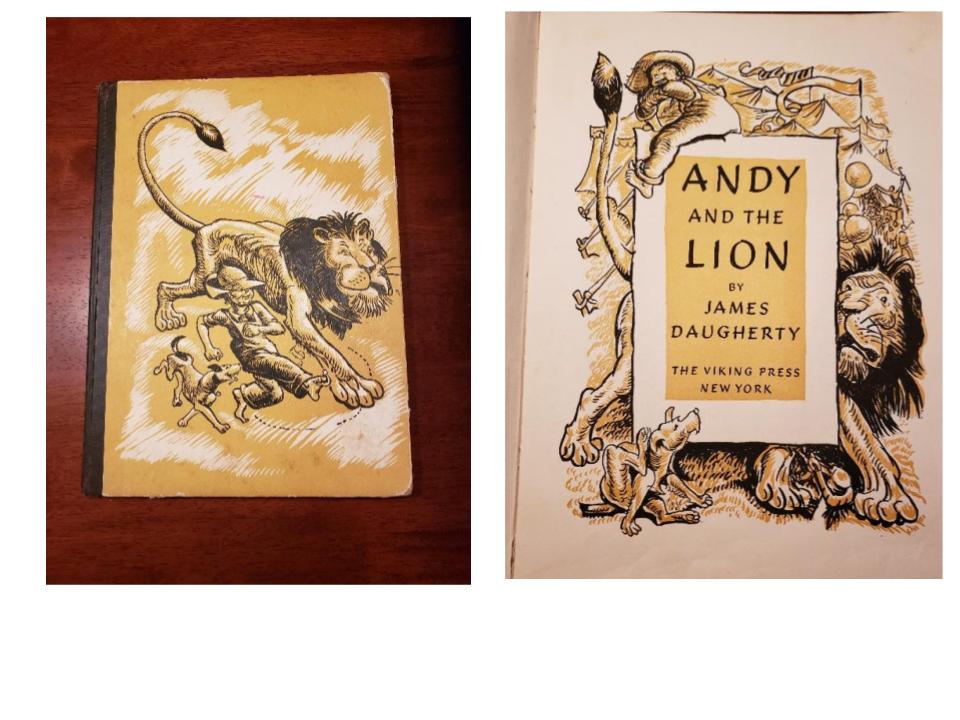
Andy and the Lion, 1939 Caldecott Honor: Combining "Fact and Fancy"

Left shows boy walking confidently alongside a happy lion in yellow, white and black. Right shows the title page of the book, which reads: Andy and the Lion by James Daugherty, The Viking Press, New York. Pictures around the title are a lion, young boy, and dog.
One of five Caldecott honor books in 1939, James Daugherty's Andy and the Lion takes a familiar fable and turns it into a heartwarming story about a child's dream come true. Daugherty's illustrations are fantastical but with enough realistic details to bring the story to life, making the story as much fun to "watch" as it is to read. For me, the brilliance of the book is that it works on many levels -- as a fable about kindness and gratitude, as a story about friendship, or as a testament to the power of books to ignite the imagination.

Noted children's book creator Lynd Ward summed it up well: "The book is gay [i.e., joyful] in its physical aspect where a yellow second color appears on every page and in its spirit of happy, carefree childhood, where fact and fancy combine into a world far more real than the prosaic pedestrianism of adult years" (Newbery Papers, p. 180).
 

Andy and the Lion:
A New Spin on a Familiar Tale 

Most of us are familiar with the fable about the suffering lion with a thorn in his paw who befriends the man who finally pulls it. In the original fable by Aesop, the the human is a slave names Androcles who escapes his master, where he meets the lion in the forest. After winning the animal's friendship, the two are captured, and Androcles is sentenced to death for running away -- specifically to be eaten by the lion. On the day of the execution, the lion refuses to eat his friend despite having been starved for several days; instead, the lion rejoices and licks the slave's hands. Shocked at this reaction, the emperor frees both Androcles and the lion. 

Subtitled "A Tale of Kindness Remembered or The Power of Gratitude," Andy and the Lion has a less grim context. Instead of slaves, emperors, and death sentences, we have a young boy who becomes fascinated by lions after a trip to his local library. In fact, he is so totally absorbed in reading and thinking about lions that he forgets simple, everyday things like washing behind his ears. Then, one day, he just happens to run into a lion on his way to school. After getting over the shock and confusion of this unlikely meeting, Andy sees that the lion is injured and helps him. The lion is grateful, and the two part ways -- that is until the circus comes to town. 

Andy, of course, will not miss the lion show at the circus for anything in the world, but to everyone's shock and horror, the biggest lion in the show escapes and he is in full lion fury. Chaos erupts and guards with guns rush to put down the escaped lion. Before they arrive on the scene, though, the lion rushes right up to Andy, and -- you guessed it -- recognizes his old pal! The two rejoice. Andy calls off the guards and leads the lion in a victory parade through town. The story ends with Andy and the lion together on a trip back to the library.

The story is as predictable as it is unbelievable, but like the fable that inspired it, it is ultimately shows good things happening to good characters -- and Daugherty's exuberant illustrations help us suspend our disbelief.

The "Interlocking Relationship Between Word and Picture" in Andy and the Lion

In the Biographical Note composed to honor his friend and colleague's Newbery award for Daniel Boone, Lynd Ward praises the innovation and technique that Daugherty exhibits in Andy and the Lion:

Any who are interested in the picture book technique as a form will do well to study the subtle nuances that have been worked out on these pages. The interlocking relationship between word and picture that is of the essence of this technique has here been carried several steps farther than I have seen in any other place, which is an event of importance in its own right (183).

Modern audiences might be perplexed at this praise. Compared to today's children's picture books, Andy and the Lion seems more dated that inventive with its three-color designs that typically appear every-other page. Moreover, the use of "cliffhanger" sentences  ("Andy thought he'd better be going and [. . .]) on several pages feels a bit contrived.

However, when we take the book in the context of 1938, Ward's point is much clearer. For example, take the spread where Andy pulls the dreaded thorn from the lion's paw. Here, we see the continuation of the text from the previous page (the thorn  . . . came . . . out) spread out on either side of the hyperbolic reactions of Andy and the lion to the action. The scene could easily appear in a picture book of today -- and nothing like it appears in the Caldecott books of the previous year.

Andy and the lion go flying to either side of the two page spread with Andy grasping the pulled thorn.

Another thing to notice the picture above is the movement; both Andy and the lion seem as if they will bounce of the page. Similarly, when the two meet and are chasing each other in confusion, Daugherty accurately captures the frenetic movement behind the lines "Whichever way that Andy ran -- there was the lion. Whichever way the lion ran -- there was Andy." In fact, we see in this picture a technique similar to what appears in cartoons even today:

Multiple overlaid images of both Andy and the lion going in different directions around a rock


One of my favorite things about the illustrations in this book is how Daugherty visualizes Andy's dreams. In the pictures below, we see Andy in the middle of the night, fully surrounded by his dreams about lions. On the right, the dream lion jumps behind the bed, while the sun smirks in the window. It's a humorous and fanciful depiction of waking up -- and yet it also captures something very true about the process for all of us. (I know that I have irrationally lashed out at my alarm as if it must feel some sort of spiteful glee interrupting my slumber...)
Two pictures: On left, Andy in the middle of the night, fully engulfed in his dreams about lions. On the right, the dream lion jumps behind the bed, while the sun smirks in the window.

The pictures not only enliven the text here but also reinforce the metaphoric language Daugherty uses to describe the end of the dream ("the lions left").

Daugherty's Blending of "Fact and Fancy" in
Andy and the Lion

While Daugherty's play with text and depiction of movement and imagination are among his top innovations in Andy and the Lion, it's the realistic details that he includes in each picture that ground the story. Among the best example of this are the expressions on the faces around the dinner table as Andy refuses to stop reading. The parents' outrage and annoyance is palpable but undercut by the oblivious glee that the baby exudes -- as well as the complete apathy of the sleeping dog who is obviously used to these family discussions. Meanwhile, Andy's pose, with his face almost on the page and his haphazard grasp on the fork, perfectly captures an engrossed reader:

Baby swings spoon in delight while mom points and scolds, father holds fork and knife upright giving a stern look while Andy reads at the dinner table, dog asleep at his foot.

This scene could be almost anyone's dinner table.

However, what really makes the illustrations magical for me is how Daugherty combines "fact and fancy" and Ward put it. A great example of this is on one of the front end papers depicting Andy reading with the lion at his feet. Despite the fact that we are seeing a boy with a pet lion, everything about the scene feels natural and normal:

Boy on big easy chair reading, feet on top of sleeping lion

May favorite example from the story is when Andy and the lion are reunited. I mean, I doubt that I will ever see a lion embrace a boy lovingly, but if I do, I am pretty sure that it will look like this:

Lion smiles with total joy, hugging young boy

The expressions and poses on both characters are perfection, and you can feel them dancing and spinning with joy.

A final example of this "fact and fancy" blending that I was to share is the spread introducing Part Two of the book. Here, Daugherty includes so many realistic natural details in the flora and fauna of the forest but in an almost surrealistic manner -- and the scene almost jumps off the page, both bursting with life and exciting our imagination. Like the forest animals on the left, we want to gaze ahead and see what happens next:
Young boy and dog march toward open fields and into the the sun from woods while forest animals look on


Reflecting on Andy and the Lion

On its Andy and the Lion story is a fun dream-come-true tale: A boy gets the lion of his dreams. It is also, as its subtitle suggests, story showing the rewards of kindness and gratitude -- and of course, it also reads as a classic story about true friendship, even between unlikely pairs.

However, I also think that you can see the book as a tribute to the power of books. After all, as the story opens, Andy us obsessively reading about lions and right before the main action, all that he read is swimming around in his brain. Perhaps the tale is what he imagines happening as he goes through his day -- and a testament to how much more magical our lives are thanks to the books that we read.

While I don't think it's necessary to read into the book so much, there are some details that make me think it's worth putting forth this second interpretation. First, the predominance of the library in the book is important, I think. The opening page dedicates the story to the lions outside the New York Public Library, and the story begins and ends with Andy going to the library. 
The emphasis on the library is interesting because it is not really necessary to the story: Andy could just as easily have been a kid who liked lions because of his grandfather's old hunting stories or because of a story he heard in school. So why include it in this tale about "the power of gratitude"?

I think the answer is found in James Daugherty's Newbery Acceptance Speech for Daniel Boone. Thanking the American Library Association for the award, he discusses the significance of libraries and librarians in his own life:

I always have a feeling of receiving a unique personal favor when borrowing books at libraries. I say to myself, how generous is this charming person to lend me, a perfect stranger, this valuable book, this priceless treasure. Or again, when returning it long overdue, I marvel at your charity, tolerance, and consideration. It revives one's shattered faith in humanity.
Therefore, I salute you not only as a counselor, guide, and friend, but more imaginatively in your magical powers to open doors into green pastures of knowledge and delight.

Clearly, Daugherty felt a tremendous sense of gratitude for everything libraries had given him, and I think it's possible that the story is an expression of this.


See more:


Saturday, August 28, 2021

Wee Gillis, 1939 Caldecott Honor: Scottish Story, Universal Theme


Left shows Thistle Edition in tan woven tweed. Title, author and illustrator named in gold letters on rectangular dark green label with a thistle emblem in the center. Right cover features a green, red, yellow and black tartan pattern in the background. WEE GILLIS is printed in bold white all caps on the top half. Below is a white box. At the top of the box, it says "by Munro Leaf" in red letters. Beneath the author credit is a portrait of the main character in black ink. It's a young boy wearing a feather cap, tweed jacket, and tartan scarf. Below the picture, it says "illustrated by Robert Lawson" in green ink.e

One of five Caldecott Honor books in 1939, Wee Gillis proves that you don't need a lot of words or color to have an impact. Robert Lawson's black-and-white illustrations help us connect with the characters and setting in Munro Leaf's simple story of a young Scottish boy who must choose between two very different ways of life. 

The Story of Wee Gillis:
Torn Between Two Worlds

First, let's get one thing clear, Wee Gillis is not actually our title character's name. It's "Alastair Roderic Craigellachie Dalhousie Donnybristle MacMac, but that's too long to say, so everybody just called him Wee Gillis." While we assume the "Wee" refers to his size, there is no explanation for how the relatives came up with Gillis. It's not important to the story, of course, but my curiosity got the better of me, so I Googled it and found two meanings: 1) young goat; and 2) servant of Jesus. Either one seems fitting, especially since (although it's never directly stated), Wee Gillis is an orphan.

Growing up without your parents is difficult enough, but that's not the source of Wee Gillis's conflict in the book. Instead, he finds himself caught between two worlds: 1) the Lowland life of his mother's relatives with their farms and cows; and 2) the Highland life of his father's relatives filled with stag hunts. He spends time with both sides of his family, learning their ways. In so doing, he becomes very strong, especially in his lungs because of the need to both shout for the cows through the mist and hold his breath for long periods to avoid scaring the stags. 

Despite the challenges of each setting, Wee Gillis has affection for both places and both sides of his family. The feeling is mutual, and when he comes of age, Wee Gillis must choose between the two. On the big day, his Uncle Andrew from the Lowlands and Uncle Angus from the Highlands take him halfway up the hill between the two clans. Each makes a case for join their side of the family. Wee Gillis is truly torn, hilariously setting the two grown men into a childlike fits, complete with foot-stomping and jumping. There argument is interrupted when a forlorn bagpiper stops for a rest. Distracted by the passerby, the men stop fighting and learn that the musician is in despair because he made a set of bagpipes that are too big for him. Both uncles fail to fill the bags with enough air to play them. Finally, Wee Gillis gets his chance, and as the picture below humorously shows, he is successful; notice the feet in the corner, showing one of the uncles who "fell of their rocks in surprise":

Boy dressed in kilt and Scottish garb is blowing into HUGE bagpipes so hard that his feet are lifted off the ground and his hat is flying through the air. In the corner, we see the feet of an uncle who toppled over in the wind that Wee Gillis created.

Such a talent needs to be used, so the man offers to teach Wee Gillis how to play, and this becomes his profession. For the rest of his life, Wee Gillis visits both the Highlands and the Lowlands, playing the biggest bagpipes on Earth -- and building his home halfway up the great hill, right between his two worlds.


Lawson's Art in Wee Gillis:
Where Setting and Characters Come to Life

Just as he did in the 1938 Caldecott Honor Four and Twenty Blackbirds, Lawson shows mastery of both the large and the small. His landscapes are sweeping and pull you in, making you feel a part of the countryside. In fact, it's so well executed that you oddly don't miss the color (at least I didn't, but then I also like black and white movies).

Two black-and-white drawings of Scottish landscapes, Left: Tiny Wee Gillis standing by a thatch-roofed house and tree in foreground  with craggy but verdant hills extending into the horizon. Right: Wee Gillis walking toward the viewer, visible but still dwarfed by winding road that leads behind him to massive hills in the distance.

In addition to creating a sense of distance, Lawson also creates a sense of height. In many of the scenes set in the Highlands, Lawson effectively uses white space to make us feel that we are high up in the clouds with the characters:

Three examples of Wee Gillis and family in the highlands.  All scense are drawn only on the top half or third of the page  in large proportions with backgrounds very small. People and things seem to be hovering in the clouds.

As impressive as these images are, it's Lawson's attention to much smaller details that makes the story come to life. As in Four and Twenty Blackbirds, facial expressions are key, but even more so here. The collage below shows one of my favorite expressions that he gives Wee Gills, as he waits in hopeful anticipation to have a chance to play the oversized bag pipes. Just above him, though, are a few of the faces that dot the background of other scenes: an old man and little girl hearing the shouting match between Wee Gillis's Highland and Lowland family members, and children listening to him play the bagpipes at the end of the story. Shock and curiosity in the first two are and palpable as the enjoyment and mischief in the third.
Top row has three pictures: 1) Old man with shocked expression and a side-eye; 2) Little girl looking curious but askance; 3) Four children peeking over a stone wall with happy and somewhat mischievous smiles.  Bottom row is Wee Gillis hoping that he will be asked to try the bagpipes.

Below are more examples of great faces in the story. Along the top row: 1) You can just feel the irritation of the Lowland relatives as they wait for Wee Gillis to return with the cows; 2) You can almost hear Wee Gillis wondering when the lecture will end, and 3) later we feel his anxiety over having to choose which set of relatives to live with permanently. 

Along the bottom row, we can see: 1) The calm, encouragement his Highland uncle exudes as he makes a case for Wee Gillis to come live with him; 2) The funny fury of the Lowland uncle as the debate continues (I think that's how we must look to children when we get angry...); and 3) The dejection of the bagpiper upon realizing that the instrument he made is too big.

Top row: 1) Three farmers dressed in several layers, holding wooden buckets.; 2) Wee Gillis surrounded by older men talking and pointing fingers; and 3) Wee Gillis looking conflicted.  Along the bottom: 1) Older man in hat looking patient and lovingly; 2) The funny fury of the Lowland uncle as he shouts and waves his hat; and 3) Old man with his head resting on his fist..

My personal favorite face, appears below. It depicts one of the Lowland relatives as they mock the Highland way of life. To me, the expression on Wee Gillis perfectly captures how children look as they politely listen, somewhat amused by how the adults are acting but not really processing (or maybe not agreeing with) everything that they say. The real treasure here, though, is the relative. You can almost hear his think, Scottish-accented, "Get a load of them!"
Wee Gillis in bottom right corner listens as his uncle laughs and points to the Highlands. The uncle is wearing a thick wool brimmed hat, coat, and scarves.

Another important contribution that Lawson makes to the book is using his mastery of facial expressions to highlight the development of Wee Gillis's strong lungs. Mentioned only three times in the 46 or so pages before the bagpiper shows up in the story, it stands out thanks to Lawson's imagery, which is not only amusing but also very helpful for young readers (or older ones with a lot one their mind):
From Top Left: 1) Wee Gillis shouting behind a cloud of mist, his mouth wide and his chest exaggerated; 2) Wee Gillis holding his breath, with cheeks puffed out and chest about to explode; and 3) Wee Gillis blowing into bagpipe with cheeks almost as big as his head.

A final note on the artwork: Looking at the pictures above, I cannot help but notice the ribbons on Wee Gillis's hat blowing in the wind. Again, Lawson shows a superior ability to capture movement, which is also apparent in the example below, where we can sense Wee Gillis's awkward pre-teen gait, his fidgeting with his clothes, and the movement of the fabric in response to his actions and the wind.
Wee Gillis walks, still getting dressed, his clothes blowing in the wind.
It's a minor detail, but it's a collection of small visual moments like this one that animate the story and make the book a special experience.

Reflecting on Wee Gillis

I will be honest. When I started my Caldecott Collection, I was not expecting much from Wee Gillis. I will admit that when I saw cover at the library bookstore, its tartan pattern reminded me of my high school uniform and the portrait on the front cover seemed a bit sad and dreary. I only decided to read it out of a sense of obligation: A collector should know their collection.

I could not have been more wrong. Told with humor and sensitivity in both words and pictures, the story is meaningful for people of any age who have to decide between two paths. More than that, it reminds us to leave open the possibility of "Option C" -- and charting a new path that brings together the best of both worlds. 

Want to know more? Check out:

Featured Post

Boris Artzybasheff: The Book Artist

  ( Close up from Page 1 of  Let George Do It! --  a keepsake book issued by the American Institute of Graphic Arts to commemorate the speec...