About Me

My photo
I am a mother, educator, traveler, and reader with boundless curiosity.
Showing posts with label Robert Lawson. Show all posts

Tuesday, October 19, 2021

They Were Strong and Good, 1941 Caldecott Winner: Unintended Consequences

 Book cover. Red dust jacket has four gold portraits of people from the 19th century outlined in gold. In the forefront is a two-sided frame opened with more detailed portraits in black against a gold background. Title appears in large white letters. Author's name in black ink

With America on the brink of a war that the rest of the world was embroiled in, it is not surprising that ALA would bestow its 1941 Caldecott gold on a book that celebrated America. Both the title and text of They Were Strong and Good unabashedly assert author and illustrator Robert Lawson's purpose: to tell the story of his parents and grandparents, and in so doing, pay tribute to the ordinary people who helped build an extraordinary nation. As he stated in a speech to the Cleveland Library Association in 1940:

Now about this book They were Strong and Good. Lots of people have asked me why I wrote it-- it hasn't much story. It is just a simple account, mostly in pictures, of my mother and my father and their mothers and fathers, my grandparents. But it is pretty much the story of your parents and grandparents too. None of them were great or famous. It doesn't matter whether they were see captains or preachers or cowboys or farmers or hardware merchants or just good mothers. They were the simple, ordinary people of the generations before us who worked hard and were strong and good and who each in his own small way helped to build up this great country out of a wilderness. They have turned all this over to us and it is up to us to keep it a great nation. I have hoped that just presenting a simple picture of some of these people would give to the young people of this time and perhaps to their parents a feeling of pride in their country and their forefathers and a feeling of greater responsibility. Right now our country could do with a lot of both. I hope that this book will cause some of the young people of today to look back and think about what they did, these parents and grandparents and great-grandparents of our, and to think about what we haven't done and to feel, as I do, a little ashamed of ourselves and to decide to do something about it, to be a little more worthy of them (Lawson, Cleveland Library Speech).

Such a pointed message was a new milestone for Lawson. He was well established as a children's book artist, having been a Caldecott runner up twice before -- in 1939 for Wee Gillis and in 1938 for Four and Twenty Blackbirds: Old Nursery Rhymes -- as well as the illustrator for the 1936 smash hit The Story of Ferdinand. However, his most popular works thus far had been noted for their humor, with enjoyment as their main purpose. Now that he had both critical and commercial success, he had earned the freedom not just to pick his own projects but to originate them as well -- and he was not afraid to use it.

Given this background, you might see this book and heave a sigh as you open it, preparing for an onslaught of traditional patriotic preaching. Even the cover, with its staid portraits and red-gold flourishes, makes you think that this book will be will be a dated and forgettable experience.

Nothing could be further from the truth -- although admittedly, the book will make an impression of different people for different reasons.

Although Lawson makes his purpose known in the Foreword to the book, the message is quite short and not nearly as heavy-handed as the speeches he gave about the book. Instead, like any good storyteller, he is quick to just get on with the action -- or in this case, to give brief accounts of the lives of his grandparents and parents. 

Each account is simple but lyrical, and Lawson chooses to focus on events that underscore the humanity of these people -- strangers to us and (at least in the case of his grandparents) distant from him. Of course, this being a Caldecott book, the exquisite artwork brings these tales fully to life.

Thus, we see his grandfather, a swashbuckling Scott, almost felled by a parrot and then smitten by the demure Dutch girl he happens upon at port. Their intense romance is only suggested, and cut short by the bride's seasickness on the way to their Caribbean honeymoon. Note the humor that the parrot brings, first undercutting the Scott's proud strut by climbing the crewman's hat -- and the pandemonium that ensues when he eats a hat; the monkey's shocked look says it all.

Picture 1: Portrait of the black-haired Scott with a low beard and no mustache in a 19th century suit with a bowtie. Picture 2: The same man, tall and dressed finely, strutting through a market with a crew member being attacked by parrots and an African American boy carrying a board and goods on his head while monkeys climb. Picture 3: The man holds a scrap of material , yelling at the parrot which is in flight. The monkey gapes in horror.

I love the smile that his mother's mother makes while his grandfather is talking to her in the wagon. It perfectly captures that flirtatious mood when you are cautioning yourself against taking a person too seriously but also hoping that they mean what they're saying.

Picture 1: Serene looking woman with a tuft of blond hair sticking out from under a white headscarf. Picture 2: A covered wagon,. Picture 3: Woman sits with her eyes closed in the wagon, smiling as a dark-haired bearded man talks to her. Picture 4: Woman hanging over the edge of a boat with rough waves.

We also see the young couple, both sick of the sea, move to Minnesota, where life proves a bit too rough for their gentle daughter, Lawson's mother, who attends a convent school where she learns, among other things, how to charm bees. Notice in these pictures how Lawson captures the raucousness of the Minnesota lumberjacks, and the horror on his mother's face -- and how just a few pages later, he creates an almost Eden-like world.

Side-by-side pictures of a dark-haired girl.  One, a teenager, lifting a beehive next to a nun without getting stung. The second is the same girl, younger, walking hand-in-hand with an unseen man (probably her father) with rowdy lumberjacks in the background. Girl's expression is one of shock.

We see his other grandfather "always fighting something," be it Satan or Yankees, and can tell from his expression that he was never at peace -- while the distant profile of his father's mother and brevity of her tale make us wonder if that fighting spirit took its toll on her. It's a glaring reminder that everyone's family has untold stories.

Side-by-side portraits two dark-haired people. She is in profile with shiny hair, eyes gazing into the distance; she wears and elaborate ruffled collar with a large necklace. He has wild hair and a stern look.

Finally, we see his father, who went off to war at the age of 14, where he got "not much of a mule" but "he was not much of a man." That would change as he taught himself to endure the suffering of battles and diminishing resources with honor -- and later to embark on a new life in New York City.


Portrait features a man with wavy dark hair and a long mustache in a cravat. Other pictures show him as a youth. One hunting with an African American boy and two dogs, another standing by a cannon in tattered clothes with a tattered flag. The next shows him almost as a silhouette walking through a destroyed town. In the final, he is a suited young man leaning over a dark-haired young woman in a gown, trying to get her attention.

Thus, Lawson provides plenty of details to help the reader connect with these ordinary people of the past. However, for modern audiences, several of these details also may make such connections impossible. The depictions of African Americans and other nonwhites, two of which appear above, have been called cliched and stereotypical, and in a few places, Lawson's language doesn't help matters. He refers to the Native Americans where his mother grew up as "tame" (wording that I believe was later changed) and makes a point of saying that his mother feared them. Readers today also may cringe (I did) at the matter-of-fact way that he writes of his father "having" Dick, a slave -- listed as a possession after his two dogs.

Such an approach clearly (and rightly) would draw criticism today -- as would Lawson's assertion that the story of his family is "pretty much the story of your parents and grandparents too." I know, for example, that it is not the story of my parents and grandparents. Far from it. And it is not the story of countless other Americans who built, and continue to "build up this great country"  (Lawson, Cleveland Library Speech).

With all of this in mind, the impact of this book depends entirely on the individual reader -- more so than most. While some will no doubt revel in its traditional patriotism, others will reject it as a not-so-subtle example of racism in children's books from a previous era. For myself, I think the book does a very good job of creating some memorable artwork and showing the humanity, however flawed, of people from a different age. I also think it could prove a useful tool to have discussions about prejudice, racism, and changing social mores -- conversations that we desperately need to start having and not shying away from. While that may not be the legacy that Lawson intended for They Were Strong and Good, I believe that it might be an even greater gift than he realized.

Lawson, R. (1940). “Cleveland Library Speech 1940.” Free Library of Philadelphia, Frederick R. Gardner Collection of Robert Lawson, Box 39, Folder 35.

For More on this Book & Artist, see:

Saturday, August 28, 2021

Wee Gillis, 1939 Caldecott Honor: Scottish Story, Universal Theme


Left shows Thistle Edition in tan woven tweed. Title, author and illustrator named in gold letters on rectangular dark green label with a thistle emblem in the center. Right cover features a green, red, yellow and black tartan pattern in the background. WEE GILLIS is printed in bold white all caps on the top half. Below is a white box. At the top of the box, it says "by Munro Leaf" in red letters. Beneath the author credit is a portrait of the main character in black ink. It's a young boy wearing a feather cap, tweed jacket, and tartan scarf. Below the picture, it says "illustrated by Robert Lawson" in green ink.e

One of five Caldecott Honor books in 1939, Wee Gillis proves that you don't need a lot of words or color to have an impact. Robert Lawson's black-and-white illustrations help us connect with the characters and setting in Munro Leaf's simple story of a young Scottish boy who must choose between two very different ways of life. 

The Story of Wee Gillis:
Torn Between Two Worlds

First, let's get one thing clear, Wee Gillis is not actually our title character's name. It's "Alastair Roderic Craigellachie Dalhousie Donnybristle MacMac, but that's too long to say, so everybody just called him Wee Gillis." While we assume the "Wee" refers to his size, there is no explanation for how the relatives came up with Gillis. It's not important to the story, of course, but my curiosity got the better of me, so I Googled it and found two meanings: 1) young goat; and 2) servant of Jesus. Either one seems fitting, especially since (although it's never directly stated), Wee Gillis is an orphan.

Growing up without your parents is difficult enough, but that's not the source of Wee Gillis's conflict in the book. Instead, he finds himself caught between two worlds: 1) the Lowland life of his mother's relatives with their farms and cows; and 2) the Highland life of his father's relatives filled with stag hunts. He spends time with both sides of his family, learning their ways. In so doing, he becomes very strong, especially in his lungs because of the need to both shout for the cows through the mist and hold his breath for long periods to avoid scaring the stags. 

Despite the challenges of each setting, Wee Gillis has affection for both places and both sides of his family. The feeling is mutual, and when he comes of age, Wee Gillis must choose between the two. On the big day, his Uncle Andrew from the Lowlands and Uncle Angus from the Highlands take him halfway up the hill between the two clans. Each makes a case for join their side of the family. Wee Gillis is truly torn, hilariously setting the two grown men into a childlike fits, complete with foot-stomping and jumping. There argument is interrupted when a forlorn bagpiper stops for a rest. Distracted by the passerby, the men stop fighting and learn that the musician is in despair because he made a set of bagpipes that are too big for him. Both uncles fail to fill the bags with enough air to play them. Finally, Wee Gillis gets his chance, and as the picture below humorously shows, he is successful; notice the feet in the corner, showing one of the uncles who "fell of their rocks in surprise":

Boy dressed in kilt and Scottish garb is blowing into HUGE bagpipes so hard that his feet are lifted off the ground and his hat is flying through the air. In the corner, we see the feet of an uncle who toppled over in the wind that Wee Gillis created.

Such a talent needs to be used, so the man offers to teach Wee Gillis how to play, and this becomes his profession. For the rest of his life, Wee Gillis visits both the Highlands and the Lowlands, playing the biggest bagpipes on Earth -- and building his home halfway up the great hill, right between his two worlds.


Lawson's Art in Wee Gillis:
Where Setting and Characters Come to Life

Just as he did in the 1938 Caldecott Honor Four and Twenty Blackbirds, Lawson shows mastery of both the large and the small. His landscapes are sweeping and pull you in, making you feel a part of the countryside. In fact, it's so well executed that you oddly don't miss the color (at least I didn't, but then I also like black and white movies).

Two black-and-white drawings of Scottish landscapes, Left: Tiny Wee Gillis standing by a thatch-roofed house and tree in foreground  with craggy but verdant hills extending into the horizon. Right: Wee Gillis walking toward the viewer, visible but still dwarfed by winding road that leads behind him to massive hills in the distance.

In addition to creating a sense of distance, Lawson also creates a sense of height. In many of the scenes set in the Highlands, Lawson effectively uses white space to make us feel that we are high up in the clouds with the characters:

Three examples of Wee Gillis and family in the highlands.  All scense are drawn only on the top half or third of the page  in large proportions with backgrounds very small. People and things seem to be hovering in the clouds.

As impressive as these images are, it's Lawson's attention to much smaller details that makes the story come to life. As in Four and Twenty Blackbirds, facial expressions are key, but even more so here. The collage below shows one of my favorite expressions that he gives Wee Gills, as he waits in hopeful anticipation to have a chance to play the oversized bag pipes. Just above him, though, are a few of the faces that dot the background of other scenes: an old man and little girl hearing the shouting match between Wee Gillis's Highland and Lowland family members, and children listening to him play the bagpipes at the end of the story. Shock and curiosity in the first two are and palpable as the enjoyment and mischief in the third.
Top row has three pictures: 1) Old man with shocked expression and a side-eye; 2) Little girl looking curious but askance; 3) Four children peeking over a stone wall with happy and somewhat mischievous smiles.  Bottom row is Wee Gillis hoping that he will be asked to try the bagpipes.

Below are more examples of great faces in the story. Along the top row: 1) You can just feel the irritation of the Lowland relatives as they wait for Wee Gillis to return with the cows; 2) You can almost hear Wee Gillis wondering when the lecture will end, and 3) later we feel his anxiety over having to choose which set of relatives to live with permanently. 

Along the bottom row, we can see: 1) The calm, encouragement his Highland uncle exudes as he makes a case for Wee Gillis to come live with him; 2) The funny fury of the Lowland uncle as the debate continues (I think that's how we must look to children when we get angry...); and 3) The dejection of the bagpiper upon realizing that the instrument he made is too big.

Top row: 1) Three farmers dressed in several layers, holding wooden buckets.; 2) Wee Gillis surrounded by older men talking and pointing fingers; and 3) Wee Gillis looking conflicted.  Along the bottom: 1) Older man in hat looking patient and lovingly; 2) The funny fury of the Lowland uncle as he shouts and waves his hat; and 3) Old man with his head resting on his fist..

My personal favorite face, appears below. It depicts one of the Lowland relatives as they mock the Highland way of life. To me, the expression on Wee Gillis perfectly captures how children look as they politely listen, somewhat amused by how the adults are acting but not really processing (or maybe not agreeing with) everything that they say. The real treasure here, though, is the relative. You can almost hear his think, Scottish-accented, "Get a load of them!"
Wee Gillis in bottom right corner listens as his uncle laughs and points to the Highlands. The uncle is wearing a thick wool brimmed hat, coat, and scarves.

Another important contribution that Lawson makes to the book is using his mastery of facial expressions to highlight the development of Wee Gillis's strong lungs. Mentioned only three times in the 46 or so pages before the bagpiper shows up in the story, it stands out thanks to Lawson's imagery, which is not only amusing but also very helpful for young readers (or older ones with a lot one their mind):
From Top Left: 1) Wee Gillis shouting behind a cloud of mist, his mouth wide and his chest exaggerated; 2) Wee Gillis holding his breath, with cheeks puffed out and chest about to explode; and 3) Wee Gillis blowing into bagpipe with cheeks almost as big as his head.

A final note on the artwork: Looking at the pictures above, I cannot help but notice the ribbons on Wee Gillis's hat blowing in the wind. Again, Lawson shows a superior ability to capture movement, which is also apparent in the example below, where we can sense Wee Gillis's awkward pre-teen gait, his fidgeting with his clothes, and the movement of the fabric in response to his actions and the wind.
Wee Gillis walks, still getting dressed, his clothes blowing in the wind.
It's a minor detail, but it's a collection of small visual moments like this one that animate the story and make the book a special experience.

Reflecting on Wee Gillis

I will be honest. When I started my Caldecott Collection, I was not expecting much from Wee Gillis. I will admit that when I saw cover at the library bookstore, its tartan pattern reminded me of my high school uniform and the portrait on the front cover seemed a bit sad and dreary. I only decided to read it out of a sense of obligation: A collector should know their collection.

I could not have been more wrong. Told with humor and sensitivity in both words and pictures, the story is meaningful for people of any age who have to decide between two paths. More than that, it reminds us to leave open the possibility of "Option C" -- and charting a new path that brings together the best of both worlds. 

Want to know more? Check out:

Tuesday, August 24, 2021

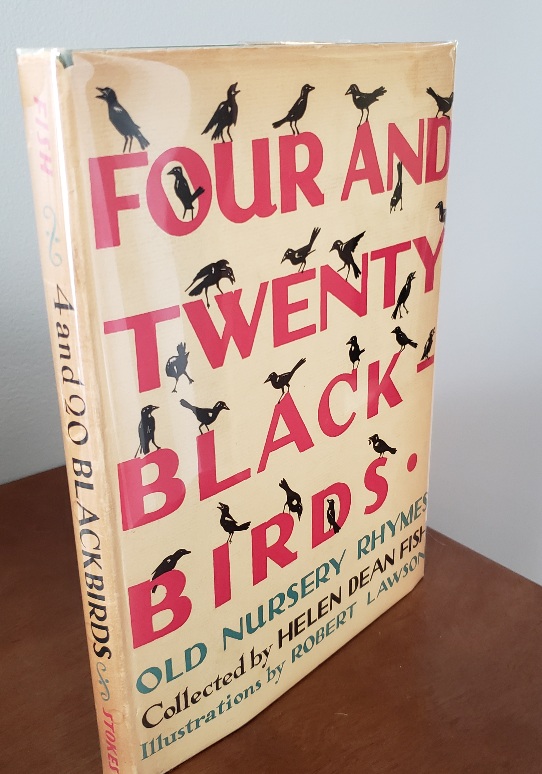
Four and Twenty Blackbirds, 1938 Caldecott Honor: A Slice of Past


Book Cover

Despite it's title, 1938's second Caldecott honor book Four and Twenty Blackbirds: Old Nursery Rhymes is not your typical Mother Goose. Collected by Helen Dean Fish, who also assembled the year's Caldecott winner Animals of the Bible, it contains lesser-known jingles that would have been "old" even to readers in 1937. Using only black and green tempera, Robert Lawson (who also illustrated 1939 honor book Wee Gillis and the 1941 winner They Were Strong and Good) created 13 memorable full-page illustrations and several smaller sketches to help resurrect these old rhymes for new audiences. The big question is whether their "pie" will satisfy today's tastes. The answer probably depends on who's at the table.

Author Helen Dean Fish on Making Four and Twenty Blackbirds

And so, with Robert Lawson's invaluable support I have put these blackbirds into a pie before they have flown away forever, with the hope that when the pie is opened they will sing both lustily and sweetly for American children -- Helen Dean Fish, "Foreword" to Four and Twenty Blackbirds: Old Nursery Rhymes

As the above quote suggests, the author/editor of Four and Twenty Blackbirds viewed the work as something more than just a children's book. In detailing her efforts to compile this collection of the non-Mother Goose rhymes and jingles that she loved as a child, Helen Dean Fish establishes herself as a one-woman Brother's Grimm.  

By seeking out old texts, mining "the memories of older people," and comparing "literally hundreds of variants" of certain songs or stories, Fish gave us a book of 24 rhymes (or "blackbirds") that "have possibly been loved as genuinely as the shorter and more familiar Mother Goose Melodies" but are "in danger of being soon forgotten and lost forever." Fish was so committed to this historic preservation that she included music for several of the songs on the last five pages of the book.

As a student of history and lover of literature, I have to say that I appreciate Fish's tremendous effort; the "Caldecott Collector" and blogger in me feels a bond with her over our similar missions. As a writer, I also have to admire her confidence when she makes statements like this one: "The value of these old songs and rhymes is not likely to be questioned, I think, by anyone who has seen children enjoy them." Even if I thought that about my work, I doubt that I would ever have the self-assurance to say it, much less to write it. 

You just don't see that type of conviction every day, and at least in terms of the preservation of U.S. oral history, it's warranted. The nursery rhymes in this book are probably obscure to most readers; when I purchased my first copy of the book several years ago, I was shocked that aside from "The Little Red Hen," I only knew the title entry (which, surprisingly, does not even have its own "chapter" in the book, instead just being tagged to the end of the Foreword). I was a little familiar with "Frog Went A-Courting," but only because the 1956 Caldecott winner by Feodor Rojankovsky (author, John Langstaff). The remaining titles -- including "The Old Gray Goose," "Old Mother Tabbyskins," and "Rufflecumtuffle" -- had me mystified. So, right away, it seemed, this was not the typical book of nursery rhymes, and I was excited to explore it.


Illustrator Robert Lawson Helps the Blackbirds Take Flight

Aside from the unique focus of the collection, the art, of course, is what makes this book stand out. Robert Lawson's green and black drawings are sometimes  bold and dramatic, sometimes delicate and whimsical, and sometimes all of these and more.  A perfect example of this is Lawson's illustration for "Little Dame Crump," about an old woman who uses a found penny to purchase a pig that is reluctant to follow her home:

Lawson’s illustration captures a beautiful expanse of countryside, suggesting the long journey that the woman had to make to the market. While the bright green in the background pulls our eye to into the sweeping scene, small details in the forefront capture our attention. While Lawson takes great pains to draw the blades of grass shimmering in the shadow of the tree, the folds in the woman’s wrap, and the cobblestones in the street, he effectively uses whitespace to cast a spotlight on the tiny pig at the center of all the action. Anyone who’s walked a stubborn puppy will recognize -- and laugh at --  the pig’s pose and expression.

Another great example of this is the illustration for "The Famous Battle of the Bumble-Bug and Bumble Bee," where Lawson plays with perspective to give these two pests heroic proportions:

Giant beetle and bee atop a giant apple with tiny town in the background

Of course, while we might expect our two warriors to dominate the forefront, Lawson takes it a step further: Not only do the bugs outsize the tiny town in the background, but their size in comparison to the apple is as fanciful as their physical features are clearly delineated. 

Lawson's attention to detail extends beyond the natural world to the fantastic, as ween in his drawings for "Come Hither" and  "Rufflecumtuffle." The first of these shows a "good little boy" enjoying his horse, a reward that he received for learning his alphabet (after the house pets refused). There is s real sense of movement in the pose of the horse, and the feathers in the boy's cap seem to be blowing in the wind. The expression on his face, too, seems to be filled with awe; while literally this may be a reaction to the letters dancing around him, the picture seems to capture the idea that reading opens magical worlds.

Young man in a cape with feathered hat rides a horse through a giant letter "A" while other letters dance about.

Lawson creates another magical world for "Rufflecumtuffle," an elf who "longed to dance in the fairies' hall / For he knew he must outshine them all." The picture on the left shows a sketch of the title elf from the Table of Contents, while the picture on the right shows his three brothers heading over to the fairy hall intending to mock him:

Above, the title elf “was a real dandy / With whiskers flowing wide and sandy.”  To the right, his brothers in their tiny, turtle-drawn wagon. Notice the sly expression on the driver’s face and the mushroom-cap wheels.

As it happens, the faces of our studious "good little boy" and dancing elf are only two of the countless remarkable facial expressions that Lawson creates for both people and animals, giving both major and minor characters a palpable personality and adding interest to the text:

Animals and people with various expressions of humor, disbelief, concentration

My favorite of these expressions is on "Little Ren Hen." The tale teaches the value of hard work: Goose, duck, dog, cat, mouse, rat all refuse to help our heroine plant, tend, and reap the wheat, wanting only to eat the result. In the end, they rightfully lose out to the industrious hen's chick's, makin g this a very traditional story with a strong, traditional moral. Our heroine should feel content and satisfied, if not a little proud.

However, taking a look at the two depictions of our title character, we don't get a sense that she is whistling while she works. In the picture on the left, she almost seems to be spitting the wheat out, while in the one on the right, you can feel the weight of the sack, which we can only imagine would not seem quite as heavy to Dog or Cat. The feature that really stands out, though, is her face. Here, Lawson uses a natural feather pattern to accentuate her sharp eyes, and we can feel her frustration:

Although her efforts are rewarded, the Little Red Hen’s face reflects the annoyance and frustration we all feel when those around us refuse to do their fair share.

These depictions of the Little Red Hen are also two great examples of how some of the smaller art scattered throughout the book adds to the experience of the text. One of my favorite examples of this is the sketch of the idyllic little town that opens the "Merry Green Fields of England": 

Reflections on Four and Twenty Blackbirds

Not all of the pictures are as bucolic ad the last picture. Like other nursery rhymes and fairy tales of old, many of the rhymes and stories featured in this book deal with some dark themes. Two, in particular, center on death and the illustrations do nothing to hide this fact:
Top picture features a dead pig with its feet up in the air. Bottom picture features a dead goose in a similar pose.

Perhaps the "feet in the air" poses of the two animals were meant to be humorous and lighten the mood of the accompanying text. In "The Old Gray Goose," death is discussed rather cavalierly: Upon finding the dead goose, the singer simply plans to bury the animal in the morning and only somewhat laments the lack of goose eggs to eat in the future. By contrast, "Jim Findley's Pig" is much darker. After finding the pig dead in its sty, Finley's wife is so grief-stricken that she dies. All of this death pushes Finley to suicide: "The old man he died soon arter /He hung himself with his garter."

Darkness also pervades some of the cautionary tales. In "The Robber Kitten," the title character defiantly leaves his mother to "go and be a robber fierce/ And live in a dreary wood!" He immediately meets a rooster "And blew its head, with a pistol, off." Although the kitten eventually returns home after getting beaten by an older cat and a dog -- and seeing just how "bad" bad can be -- the "lesson" seems more rooted in a desire for self-preservation than an understanding of right and wrong. Lawson's artwork only underscores this darkness, as he chooses to illustrate the wayward kitten, not the enlightened one. His drawing for the tale is reminiscent of old cartoons and, as such may make them chuckle; however, for others it may seem a bit too graphic:

Kitten dressed in trench coat and fedora holding gun. Blast from gun obscures top portion of rooster. Flying feathers and bird claws.
I have laughed quite a bit at the violence in old cartoons like Tom and Jerry or Coyote and Road Runner. However, while those characters have a million lives, the death here was real. This fact and other events in the story, including the kitten going on a drinking binge with the dog, made me take the tale perhaps too seriously. 

"The Tragic Tale of Hooty the Owl" likely also was intended to inspire some  smiles and giggles, but also left me unsettled. Here, an owl sends a local hunter in the direction of the fox who ate his son. When the fox dies after putting up an extended fight, the owl laughs at his fate: "And the owl looked down from the branch overhead/ Where the lifeless, tailless fox lay dead, / And laughed aloud as away he flew, / 'Too-whit, too-whit, too-whit, too-whoo!" While I wanted to see the fox get his comeuppance for eating the owlet, laughing over a corpse seemed a bit too macabre.

Of course, maybe my reaction is more a critique of modern society. Taking risks, like running away from home, can lead to real danger. Vengeance can transform a victim into a villain. Violence is, after all, violent. No one would argue these points, and yet we shield children from these truths by creating cartoons and action movies with characters that often survive impossible circumstances -- or by sanitizing these ideas to a point where they barely resemble the lessons that they are meant to show. 

Who is doing more harm? It's an interesting question to ponder as we think about rising numbers of children's mental health issues in today's world and wonder if that's due to our actions, changes in our social fabric, or simply greater awareness of problems that always existed.

If the violence in some of these rhymes doesn't goes too far for you, some of the male chauvinism might. Given the fact that this book was written in 1938 and attempted to preserve an oral tradition dating back even further, I expected rhymes such as "Joe Dobson." In this jingle, a man brags he can outdo his wife with the house chores. She takes him up on the challenge, but he is overwhelmed by her everyday tasks and thwarted by the farm animals: "Joe suddenly confessed/He was convinced that wives could do/ The household business best." Honestly, aside from the last three lines, it's a rather funny rhyme and easily seems the stuff any sitcom in which people trade roles.

The same cannot be said for "Mr. Bourne and His Wife." In the rhyme, the title characters get into a fight over bread, toast, and butter. Their neighbor "overhear[s] the splutter" and attacks Mr. Bourne, saying, "'By my life, / You shall not beat your wife! / It is both a sin and a disgrace!'" In return, Mrs. Bourne attacks him and sends him running. The listener is cautioned not to poke "his snout in" if  "married folks are flouting." My guess (hope?) is that the scenario is a humorous dramatization of more nuanced disagreements and interference --  and thankfully Lawson's illustration (below) supports this interpretation. However, given the language, it really just seems to advise looking the other way in cases of spousal abuse.

Man running from doorway with pans and kitchen items being thrown at him.

While I truly believe that it is important to read older works in the time period of their era and not be overly critical of them in light of modern standards and tastes, I do think that I would have great difficulty reading or singing many of these rhymes to a child -- particularly one at a "nursery rhyme age." Just as I cannot change the time period in which these rhymes developed and were recorded, I also cannot change the time period in which I grew up and now live. 

Still, I am glad that someone took the time to preserve these rhymes. Not only does it give us a sense of what life was like "back then," but it also gives us a new lens through which we can view our own cultural perspective. The book also proved a wonderful vehicle to experience the art of one of the great children's illustrators, Robert Lawson, who does more in two colors than many can accomplish with a full palette. 

Thus, as the book's creator, Helen Dean Fish predicted, I am "not likely" to question "the value of these old songs and rhymes." However, for me at least, times have changed too much for children to "sing both lustily and sweetly" many of the songs in this book. Whether this legacy would be enough for Fish is a question that must remain unanswered.


Featured Post

Boris Artzybasheff: The Book Artist

  ( Close up from Page 1 of  Let George Do It! --  a keepsake book issued by the American Institute of Graphic Arts to commemorate the speec...